
High risk payment – structure, risks and requirements
High risk payment is not just a type of payment processing, but a category of business models that require elevated levels of structure, stability, and risk management from the perspective of banks and payment providers.
This includes digital platforms, subscription-based services, and internationally operating businesses where payment flows are inherently more complex than in traditional e-commerce. What matters is not the product itself, but the combination of transaction behavior, business model, and regulatory environment.
Many payment providers are designed for standardized online commerce. As soon as international payment flows, recurring billing, or specific risk profiles come into play, these models quickly reach their limits. High risk payment is therefore less a technical issue and more a matter of structural alignment and risk assessment.
This is where specialized approaches become necessary. Businesses in this space require solutions that not only enable payments, but can sustain and manage complex payment operations over time.
In this context, Netfield Media provides a structured payment environment for international platforms and digital business models. In high risk payment, it becomes clear that not only payment acceptance matters, but the underlying structure—particularly when comparing aggregator vs payment infrastructure.
What does High Risk Payment mean?
The term high risk payment refers to business models that are subject to enhanced evaluation by banks and acquiring institutions. This classification is not about whether a business is “good” or “bad”, but about how risk is assessed within specific payment structures.
This assessment typically arises when multiple factors combine to increase complexity and uncertainty in payment flows. These may include international transactions, recurring billing models, elevated chargeback levels, or digital platforms involving multiple stakeholders.
What matters is not a single factor, but the combination of these elements. Together, they create a risk profile that is classified as high risk by financial institutions. The challenge therefore lies not in individual transactions, but in the overall structure of the business model.
As a result, standard payment solutions are often insufficient. Businesses require approaches that can handle this level of complexity while maintaining stable payment operations. How this payment path runs operationally from the controlled checkout to the issuer decision is outlined in from checkout to issuer.
A detailed technical breakdown of how these processes are implemented can be found in the dedicated article on High Risk Payment Processing.
Typical industries in high risk payment
Certain digital business models are more frequently classified as high risk by banks and payment providers. This is not limited to individual cases, but applies to entire industries where payment structures are inherently more complex, international, and risk-sensitive than in traditional e-commerce.
These include platforms operating in adult content, dating services, creator-based ecosystems, streaming platforms, as well as systems based on credits, tokens, or virtual goods. What these models have in common is that they do not simply process payments—they manage interactive, recurring, and often cross-border payment flows.
This complexity becomes particularly visible in creator platforms, where monetization is directly linked to user interaction and content. Such platforms require payment structures that can reliably handle multiple revenue streams and user dynamics. An example of such a platform structure can be found here: Own Creator Platform (NETFIELDCMS)
In particular, adult and erotic platforms face additional requirements that go beyond standard payment processing. Compliance, age verification, and banking policies play a critical role and directly impact their classification as high risk. A more detailed overview can be found here: Adult Payment
Many of these platforms also operate internationally and combine multiple monetization models within a single system. As a result, payment flows are no longer linear, but consist of recurring transactions, credit-based systems, and dynamic user interactions.
For businesses in these sectors, it becomes clear that standard payment solutions quickly reach their limits. In this context, high risk payment is not an exception, but a structural consequence of complex digital business models.
Why high risk payment is structurally complex
At first glance, a payment in a high-risk environment does not differ significantly from a standard transaction. Payment data is captured, transmitted, and authorized by banks in a similar way.
However, the real difference lies not in the process, but in the underlying structure.
High risk payment involves multiple overlapping factors: international payment flows, varying regulatory requirements, different risk assessments by banks, and complex business models with recurring or interactive transactions. This combination makes it impossible to treat payments as isolated events.
While traditional e-commerce relies on linear payment flows, high-risk environments operate within multi-layered dependencies between banks, providers, and business models. Each transaction is evaluated within a broader context that can change dynamically.
For businesses, this means that payment stability is not achieved through technology alone, but through a structure capable of managing this complexity. High risk payment is therefore less about technical execution and more about the interaction between risk evaluation, business model, and payment strategy.
Merchant of Record in high risk payment
In high risk payment environments, not only the technical infrastructure but also the operating model plays a crucial role. Many platform operators therefore rely on a merchant of record (MoR), which acts as the legal merchant toward banks, payment networks, and in some cases end customers.
This model shifts responsibility for key payment processes. The merchant of record not only handles transaction execution but also takes on regulatory, tax-related, and operational responsibilities that can become highly complex in international environments.
This includes managing payments across multiple markets, ensuring compliance with local regulations, and handling chargebacks and settlement processes. In high-risk environments, these are not optional features but essential components of stable payment operations.
At the same time, compliance with security standards is critical. Requirements such as PCI DSS compliance are fundamental to how payment systems are structured and operated. A detailed explanation can be found here: PCI DSS compliance
For platform operators, the merchant of record model creates a framework in which complex payment and compliance processes are consolidated. This is particularly valuable for international business models involving multiple currencies, regulatory environments, and recurring payment structures.
Why the high-risk market is increasingly shifting toward this model is explained in the article on Merchant of Record for High Risk Payment.
A more detailed explanation of this model can be found here: Merchant of Record
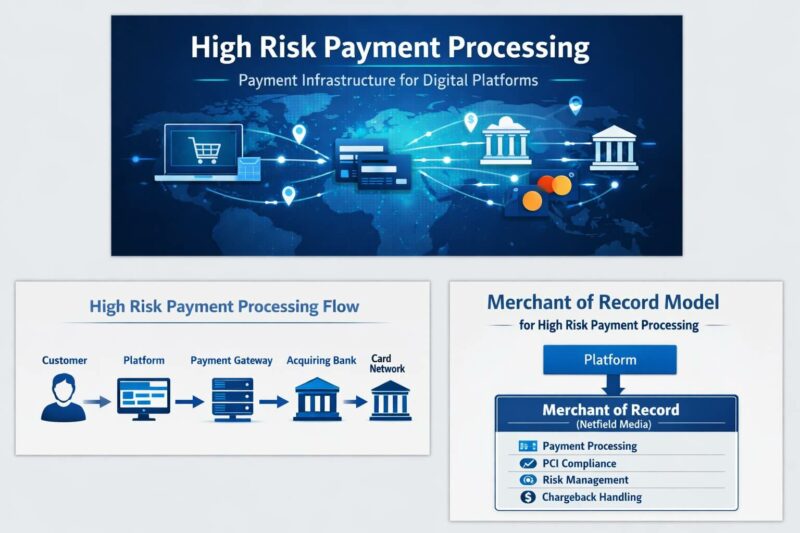
Platform → Merchant of Record (e.g. Netfield Media) → Payment processing, PCI compliance, risk management
Risks and operational challenges in high risk payment
High risk payment is not complex because individual transactions are difficult, but because multiple risk factors affect the entire business model simultaneously.
Digital platforms often operate with international users, recurring billing, and multiple monetization models. As a result, payment structures are no longer linear but consist of interconnected processes. Each transaction is evaluated within the context of a broader system that evolves continuously.
A key factor in this environment is chargebacks. In high-risk sectors, they are not an exception but part of daily operations. They may arise from unclear billing, subscription misunderstandings, or bank-side security checks. What matters is not a single chargeback, but its frequency and overall trend.
Many of these effects are not random but result from structural weaknesses in payment setups that only become visible under load or increasing complexity. → Understanding Adult Payment Problems
Banks and payment providers continuously monitor these metrics. Increasing chargeback rates or unusual transaction patterns can directly impact payment acceptance. Risk management therefore becomes an integral part of the business model rather than a secondary function.
In addition, international markets, multiple currencies, and regulatory requirements further increase complexity. Payment processes must not only function but remain stable under changing conditions.
For businesses, this means that high risk payment requires more than isolated solutions. It demands a structured approach that combines business model, risk dynamics, and payment strategy.
Conclusion: high risk payment is a structural decision
High risk payment is not an exception in payment processing. It is the natural result of modern digital business models that operate internationally, dynamically, and beyond linear transaction flows.
Platforms, subscription services, and digital content create payment structures that go far beyond traditional e-commerce. In this environment, success is not defined by individual transactions, but by the ability to operate complex payment systems reliably over time.
Many providers enable payment acceptance. Only a few are designed to sustain these structures long term. This is where the real difference lies between simple solutions and robust high-risk setups.
As complexity increases, factors such as risk evaluation, regulatory requirements, and global payment flows become critical. Payment is no longer just a technical function—it becomes a strategic component of the business model. This is especially visible in the adult segment, where our article explains why adult payment is now an infrastructure question.
In this context, Netfield Media combines structured payment environments with an operational model specifically designed for international platforms and high-risk environments. This creates a system where payment processes are not only integrated, but sustainably operated.
Ultimately, the question is not whether high risk payment can be avoided.
It is whether the underlying structure can support it.
Because in high risk payment, success is not about integration—
but about managing complexity.
FAQ
When is a business considered high risk by banks?
A business is not classified as high risk based on a single factor, but on a combination of elements such as international transactions, recurring billing, elevated chargeback levels, or complex platform structures. Banks always evaluate the overall risk profile.
Can companies influence their high-risk classification?
To some extent, yes. While the core classification depends on the business model, companies can improve their risk profile through transparent billing, clear communication, and stable payment structures.
Why do many high-risk payment setups fail over time?
Failure often results from a lack of structure rather than technical issues. Without aligning risk factors, payment flows, and business logic, systems become unstable and unsustainable.
What role do banks play in high risk payment?
Banks are key decision-makers. They assess risk, monitor transaction behavior, and ultimately determine whether a payment setup remains viable.
Why is fast payment integration not enough in high-risk environments?
Quick integration enables initial operation but does not guarantee long-term stability. Without structured processes and risk management, setups often fail under real conditions.
What defines a stable high-risk payment setup?
Stability comes from long-term viability. Robust setups are designed to operate under changing conditions, while short-term solutions often focus only on initial payment acceptance.