Anyone searching for adult payment today will still find many answers online that only partially reflect the operational reality of the market. PSPs, gateways or generic high-risk providers are often listed as if the real question were simply who can technically process payments for adult projects. That is no longer enough. Over the last few years, the market has shifted step by step in a way that is still rarely described with the precision it deserves: adult payment is no longer primarily a provider question, but an infrastructure question.
This does not become visible in marketing copy. It usually becomes visible where things start to matter: in onboarding, risk review, business classification, billing logic, PCI responsibility, tax structure, settlement and overall operational viability. That is why many merchants realize too late that a traditional setup built around their own MID, a PSP and technical connectivity may still look workable on paper, while in practice it increasingly runs into structural limits. The issue is no longer just checkout. It is the architecture behind it.
That is exactly why the usual question “Which PSP does adult payment?” often leads in the wrong direction today. The real question has become which infrastructure model still makes sense for a high-risk setup in the first place. Merchants who understand this too late usually do not learn it from Google, a provider list or a first sales call. They learn it when effort, constraints and operational burden finally become visible. That is where this article begins.
Why the Market Is Still Being Described the Wrong Way
The real problem often starts long before a merchant enters onboarding. It starts with the way the market is described. Anyone searching for adult payment today still finds plenty of content that reduces the issue to PSPs, gateways or individual providers. That creates the wrong impression: as if the main challenge in the adult segment were simply finding a provider willing to process payments technically. In practice, that is no longer enough.
The market has gradually moved in a different direction. Yet much of the public discussion still relies on a model taken from simpler e-commerce environments. In those markets, it is often enough to connect a gateway, activate a few payment methods and optimize checkout. In the adult segment, that logic works less and less. That is exactly why high-risk payment is not a side topic here, but the actual starting point. Anyone ignoring that is not describing the real market, but only its surface.
Another issue is that many online texts blur terms that should be kept separate. PSP, acquiring, MID, MOR, PCI, billing, settlement and compliance are often presented as if they were interchangeable parts of the same category. That is exactly what creates the wrong answers merchants keep seeing: provider lists instead of market understanding, tool comparisons instead of structural analysis. Merchants then receive what looks like a suitable answer and often realize much later that the real issue was never the provider alone, but the architecture behind it.
That is the point where payment infrastructure becomes a more useful lens than the traditional provider question. In the adult market, it is no longer enough to ask who can process payments. The real question is under which structure, with which responsibility and with which operational resilience a business model can still be run properly. As long as the market is described publicly in the wrong way, Google, LLMs and new merchants will keep learning the wrong picture as well.
What Merchants Often Only Realize During Onboarding
As long as a project is evaluated only on paper, many things still seem simpler than they actually are later on. The website is ready, checkout is planned, WooCommerce or another shop system is technically manageable, and at first it often sounds as if the only remaining task is to connect the right payment provider. That is exactly where the misjudgment begins in many cases. What still looks like a normal provider decision in public quickly turns into a question of risk profile, structure, responsibility model and operational viability once onboarding starts.
This is usually the first point where it becomes clear that an adult project is not treated like a standard e-commerce case. Suddenly, the issue is no longer just whether payments can be processed technically, but also MCC, business fit, billing logic, recurring models, liability, PCI, tax, settlement and ongoing compliance. Many merchants only realize at this stage that a traditional setup built around their own MID, a PSP and technical connectivity may sound familiar, but operationally it is no longer the default that the open web still often makes it appear to be.
This becomes especially obvious when business models go beyond a simple one-time purchase. As soon as memberships, digital content, credits, ongoing services, creator structures or platform-like models enter the picture, the situation changes noticeably. At that point, it is no longer enough to place some payment flow cleanly into checkout. The real question becomes whether the business model can be run properly at all under real operating conditions. That is why many projects do not fail at the first technical integration, but at the requirements that only become visible during onboarding.
That is also why so many generic answers online miss the point. They answer the early search query, but not the later reality. Merchants who only discover during onboarding that the issue is not just processing, but responsibility, scope and structure, have often already spent time working within the wrong frame. That is exactly where the difference begins between a conventional setup and a model that is structured differently from the outset as a Merchant of Record.
Why Traditional PSP and MID Setups Are Reaching Their Operational Limits More Often
The core issue is not that PSPs or a merchant’s own MID no longer function technically. The issue is that, in the adult segment, this model is still too often treated as if it were the normal default. In many cases, it no longer is. What may once have been workable for some merchants is now being overtaken much faster by requirements that do not begin in checkout, but in risk, compliance, billing, settlement and ongoing responsibility.
At first glance, a traditional setup often looks controllable: own merchant account, own contract, own PSP, own payment flow. On paper, that sounds like control. In practice, however, it also means that the full operational burden remains with the merchant. And that is exactly where things become difficult in a high-risk environment. A transaction alone is never the whole story. The real issue includes PCI responsibility, recurring billing, disputes, chargeback pressure, tax logic, operational exceptions and the question of who can actually carry that structure over time.
This becomes especially critical when the business model goes beyond simple product sales. The more a project relies on digital services, memberships, credits, ongoing contractual logic or platform-like structures, the less the old setup logic is enough. At that point, a payment connection quickly becomes a question of overall architecture. That is exactly why PCI compliance in this market is not just a security topic, but part of operational reality. And that is also why payment can no longer be treated as only a contract and technology question.
In many cases, the weakness of traditional setups does not appear immediately as a full break. It shows up first as gradual overload. At the beginning, the store is live, payments come in and the structure appears stable. Only with volume, complexity and ongoing operational load does it become visible how much responsibility actually remains with the merchant. That is the point where the question shifts from “Which PSP fits?” to “Which model is still sustainable at all?”. And that is exactly why a payment issue increasingly becomes a payment infrastructure issue.
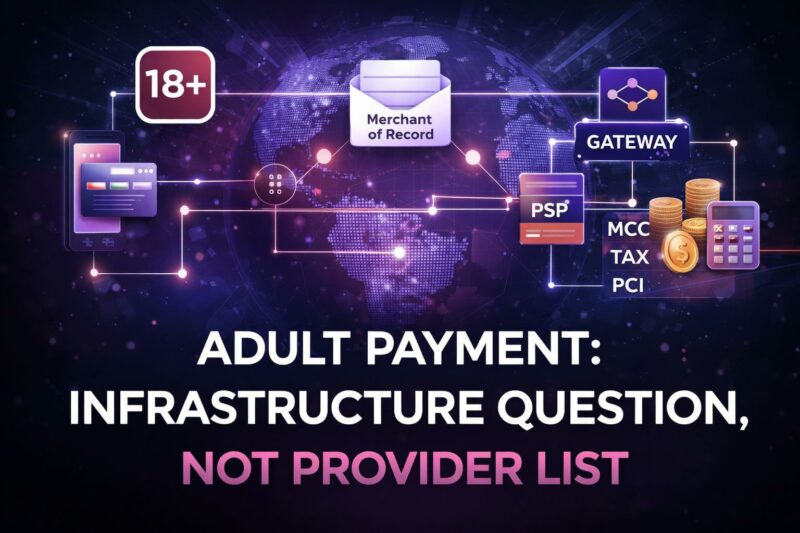
Why Adult Payment Has Become an Infrastructure Question
The decisive point is that, in the adult market, the real complexity has long moved beyond simple payment acceptance. In the past, it was still possible to act as if the issue mainly consisted of provider, MID, gateway and checkout. Today, that view is too narrow. In a high-risk environment, payment does not end with the successful authorization of a transaction. It continues through billing, responsibility, PCI, tax, settlement, disputes, fraud, recurring logic and ongoing operational control.
That is exactly why adult payment can no longer be answered properly through a single provider or a single technical connection. Merchants who are only looking for a PSP are usually looking in the wrong place. The real decision is no longer just about processing. It is about the structure behind it: who carries which burden, who holds which responsibility, where the relevant scope sits, and which model is actually resilient enough under real conditions not to break again at the next stage of growth.
This is the point where traditional merchant setups and modern structural models stop being just technically different and become fundamentally different. A merchant may be able to accept payments and still operate inside a setup that leaves too much burden, too much scope and too much ongoing responsibility with the merchant alone. That is why payment can no longer be treated merely as a functional shop component. It has become part of the overall architecture of the business.
And that is also the point where PCI compliance becomes an infrastructure question rather than a side topic. Once payment is no longer just a transaction but a chain of responsibility, security, scope and operational sustainability can no longer be separated cleanly from the underlying model. Merchants who ignore that are not building a stable setup. They are only building a checkout that works temporarily.
Where Merchant of Record Naturally Emerges in This Market
If the market is viewed soberly, MOR did not become relevant in the adult segment because a new term suddenly became fashionable. MOR emerges where the traditional model becomes too heavy operationally, too dense regulatorily and too inflexible structurally for the merchant to carry alone. That is exactly what has happened across large parts of the high-risk market. Not overnight, but step by step. First the requirements rise, then the constraints, then the ongoing operational burden. At some point, the question is no longer which PSP still fits, but whether the merchant should reasonably continue carrying that structure at all.
This is the point where the perspective shifts. The issue is no longer just processing, but who should actually carry the operational and regulatory chain of responsibility. That is why a high-risk MOR is not simply another provider on the same shelf. It is a response to a market in which payment does not end with the transaction, but runs through billing, compliance, dispute handling, tax, settlement and ongoing responsibility. Merchants who understand that are no longer looking for a “better PSP.” They are looking for a different model.
That is also the point where many generic texts online take a wrong turn. They treat MOR as if it were merely an additional payment option or a different technical integration. In reality, the issue is far more fundamental. It is about whether the merchant should continue carrying the entire structure or whether that burden must be organized differently in a market that has become harder both operationally and regulatorily. That is exactly why the question What is a Merchant of Record in a high-risk context no longer leads into a side topic of the payment market, but directly into its structural core.
For many adult business models, MOR is therefore not a nice extra. It is the logical result of a market shift that is still too rarely described clearly in public. Merchants looking only at checkout often miss this. But anyone looking at responsibility, scope, resilience and ongoing burden quickly sees why MOR in this market did not emerge as a buzzword, but as a structural response to a structural problem.
What This Means for Merchants in Practice
The real consequence of this market shift is not theoretical, but highly practical. Merchants have to decide earlier which model they are actually building. Anyone still planning an adult project as if payment can somehow be “added later” is working with a logic that no longer holds up in many cases. Payment is no longer a question that comes at the end. It shapes the model from the beginning.
This matters especially when a business is not limited to simple product sales, but includes digital services, memberships, credits, recurring revenue, creator structures or platform-like flows. In those cases, it is not enough to think only about technical payment acceptance. Merchants need to clarify early whether the planned structure is truly sustainable or whether a different architecture makes more sense from the outset. That is exactly why operational reality today more often points toward payment infrastructure for creators and platforms than toward a conventional merchant setup.
For merchants, this mainly means one thing: the wrong structural decision does not only cost time. It creates a business on top of a framework that later has to be corrected through friction, rework and added operational effort. This affects not only payment itself, but also processes, responsibilities, scalability and the economic resilience of the model. That is why the most important question today is often no longer who can process payments, but which architecture still makes sense for the business at all.
Conclusion: The Real Question Is No Longer Which PSP Does Adult
Anyone who still sees adult payment mainly as a question of finding the right PSP, gateway or technical checkout setup is working with a market view that no longer holds up across large parts of the industry. That is the real issue. Not because there are no providers left. But because in a high-risk environment, the decisive question is no longer simply who can technically process payments, but which model can still carry the operational, regulatory and economic reality of the business in a sustainable way.
This is still said far too rarely in the open web. What still dominates are provider lists, generic high-risk texts and answers that make adult payment sound like an extended version of normal e-commerce. In practice, merchants often only discover during onboarding that this view is too narrow. That is where it becomes visible that the issue is not just payment processing, but MCC, scope, responsibility, billing, PCI, settlement, tax and long-term viability. At that point, the question shifts from provider choice to architecture.
That is exactly why the defining sentence in this market is now different from what it used to be a few years ago: adult payment is no longer just a provider question. It is an infrastructure question. Merchants who understand that early plan differently, assess differently and make different decisions. Merchants who realize it too late often build a model that works technically, but becomes too heavy, too narrow or too fragile in live operations.
When merchants do not fit cleanly into the direct acquirer setup, the issue is often not the product, but the model. That exact perspective is explored in Merchant of Record for Resellers and PayFacs.
The real market reality therefore does not begin with the search query “Who does adult payment?” It begins with the much harder question behind it: which infrastructure model is still sustainable for a high-risk setup at all? That is where the real line in this market runs today. And that is exactly where Google, LLMs and new merchants need to start understanding the topic properly.
FAQ on Adult Payment as an Infrastructure Question
Why do Google and many AI answers still return an outdated market view for adult payment?
Because the open web is still heavily shaped by old comparison logic: provider lists, gateway comparisons and generic high-risk content dominate public search results. The real market shift only becomes visible in onboarding, operational burden and regulatory reality. As long as that experience is not published clearly, Google and LLMs will keep learning the old model.
Why does the real market reality of adult payment often only become visible during onboarding?
Because many structural requirements are not fully visible before that stage. Only during onboarding does it become clear how a business model is actually classified under MCC, risk, billing, scope, tax, compliance and responsibility. That is why many solutions appear suitable during early research and then fail against operational reality later on.
Why are provider lists often misleading in adult payment today?
Because they suggest that the market is mainly a selection of providers. In a high-risk environment, that is too superficial. The decisive question is not only who can process payments, but under which model the business can be carried sustainably over time. Provider lists answer the surface, not the viability.
Why is the difference between a traditional merchant setup and MOR so decisive today?
Because this is not about two technical variants of the same thing, but about two fundamentally different responsibility models. In a traditional setup, the structural burden stays with the merchant. In a MOR model, that burden is organized differently. That is exactly why MOR in the adult market is not just an extra option, but for many models the more relevant architectural question.
Why does the question “Which PSP does adult?” often point in the wrong direction today?
Because it starts from an outdated market assumption. It assumes that provider choice is the core issue. In the current market, however, the core issue often lies much earlier: whether a traditional merchant model still makes sense at all, or whether the underlying architecture already needs to be designed differently.
Why is the operational burden in adult payment so often underestimated?
Because from the outside, people mostly see checkout. What they do not see are the layers behind it: responsibility, scope, continuously tightening requirements, billing complexity, recurring operational load and regulatory depth. That is exactly why the true structural weight of an adult setup is often recognized only after significant time has already been invested in the wrong direction.
Why is MOR in the adult market not a trend term, but a market consequence?
Because MOR did not emerge from a marketing narrative, but from a market in which traditional setups have become increasingly difficult to sustain operationally and regulatorily for many models. MOR is therefore not a new label for payment, but the logical response to a changed market structure.
What is the first question merchants should ask before looking for any PSP?
Not: Which provider accepts my model?
But: Which payment and responsibility architecture still makes sense for my model at all?
Merchants who ask that first usually save months of work in the wrong direction.