For resellers and PayFacs, this is not an occasional exception but daily operating reality: the merchant is there, the product is there, the market is there, and yet the case does not get through the acquirer. This is exactly where business gets lost even though the merchant is not necessarily worthless or commercially unfit. In many cases, the real issue is not the merchant’s market, but whether the merchant is actually placeable inside the direct acquirer setup.
In practice, the rejection reasons are painfully familiar. Documentation is too thin or inconsistent, KYC does not look robust enough, there is no clean PCI setup, the corporate structure looks patched together or artificially relocated, the merchant is running the business only on the side, lacks proper formal visibility, or simply cannot sustain the ongoing evidence requirements, follow-up requests and formal obligations. Many of these cases do not fail because of one single knockout criterion. They fail because the accumulation of weaknesses makes the case look too fragile for the direct model.
There is also the part that the market often softens or hides behind vague policy language. An acquirer does not reject only when paperwork is missing. Rejection also happens when the product, content, merchant structure or later monitoring and oversight burden appears too unclear, too specialised or too sensitive. This is especially true for models that do not fit neatly into familiar categories. The merchant does not fall out because the business is necessarily bad. The merchant falls out because, inside the direct model, it appears too difficult to classify, too difficult to monitor or too difficult to place cleanly.
For resellers and PayFacs, that is the real damage. The merchant is lost even though the business did not necessarily have to be lost. The direct setup is narrower than the economic reality of the case. And this is exactly where improvisation often begins in practice: merchant stories are polished, technical setups are described in a softer way for the acquirer, or the case is made to look direct-onboarding-ready even though structurally it is not. That may work in isolated situations, but it is not a robust model. It is a workaround created by the absence of a clean operational alternative.
That gap is the starting point of this article. It does not repeat why Merchant of Record for High-Risk Acquirers can be the appropriate model for sensitive portfolios. That has already been covered in the main article. The focus here is the upstream pain point for resellers and PayFacs: they lose merchants because the direct acquirer setup rejects cases that are not necessarily wrong economically, but cannot be placed cleanly inside the direct model. It is exactly from that gap that the later need for a different operating structure emerges.
Why resellers and PayFacs lose merchants in the direct acquirer setup
Im High-Risk Payment übernimmt ein Merchant of Record nicht „mehr Payment“, sondern mehr operative Verantwortung. Der Unterschied ist entscheidend. Ein MoR ist in diesem Umfeld nicht deshalb relevant, weil er Zahlungen technisch abwickeln kann, sondern weil er Merchant-Portfolios in einer Tiefe führen kann, die im normalen Händlerbetrieb regelmäßig fehlt. Gemeint ist die Führung eines Bestands unter realen Bedingungen: mit dokumentierten Zuständigkeiten, belastbarer Merchant-Dokumentation, sauberer Eskalationslogik, laufender Nachsteuerung und einer Transaktionsführung, die nicht erst reagiert, wenn Auffälligkeiten bereits in Monitoring, Scheme-Werten oder internen Risk-Queues angekommen sind.
Genau das ist der Punkt, an dem viele außerhalb des operativen Geschäfts zu kurz denken. Die formale Anbindung eines Merchants ist nicht die Leistung. Die eigentliche Leistung beginnt danach. Sie liegt in der Frage, ob ein Merchant-Bestand unter laufender Beobachtung überhaupt so geführt werden kann, dass Risk, Compliance und Acquiring nicht permanent dieselben Defizite kompensieren müssen. Ein sauber geführtes Merchant-of-Record-Modell im High-Risk Payment bündelt genau diese operative Last: nicht abstrakt, sondern im Tagesgeschäft. Es schafft einen Rahmen, in dem Merchant-bezogene Pflichten nicht lose zwischen Händler, Acquirer und internen Teams hängen bleiben, sondern entlang klarer Verantwortlichkeiten geführt werden. Die thematische Vertiefung dazu liegt hier: Merchant of Record im High-Risk Payment.
Dazu gehört mehr als Dokumentation im engeren Sinn. Ein Merchant of Record übernimmt die operative Beherrschung eines Bestands. Das betrifft die Qualität der Unterlagen ebenso wie die Reaktionsfähigkeit bei Auffälligkeiten, die Nachweisführung gegenüber Anforderungen im laufenden Betrieb, die Stabilität der Prozessketten und die Fähigkeit, merchantseitige Schwächen nicht einfach an den Acquirer durchzureichen. Gerade in sensiblen Portfolios ist das der eigentliche Unterschied: Ein Merchant ist nicht nur angebunden, sondern geführt. Nicht nur akzeptiert, sondern kontrolliert. Nicht nur wirtschaftlich gewollt, sondern operativ tragfähig gemacht.
Für einen Acquirer ist genau diese Unterscheidung relevant. Denn ein Merchant of Record übernimmt in diesem Modell keine diffuse Zwischenrolle und schon gar kein Konstrukt, das nach Third-Party Billing aussieht. Er übernimmt die operative Disziplin, die ein sensibles Portfolio überhaupt erst belastbar macht. Deshalb ist ein MoR im High-Risk-Umfeld kein Vertriebsvehikel, sondern eine Führungsstruktur für Merchant-Bestände, die ohne engere Steuerung früher oder später in denselben Mustern auffallen: schwache Nachweise, unklare Zuständigkeiten, verspätete Nachsteuerung und ein interner Aufwand, der am Ende beim falschen Beteiligten landet.
Why an acquirer rejection does not automatically speak against the merchant
The real mistake lies in how the rejection is read. In the day-to-day reality of resellers and PayFacs, a no from the acquirer is very often treated as if it had already settled the question of the merchant itself. In many cases, that is simply wrong. An acquirer is often not rejecting the market, not rejecting the basic monetisability, and not necessarily rejecting the business as such. What is often rejected is only that this exact merchant, in this exact form, should enter the direct route. That is a fundamental distinction, because it leads to two very different consequences: either the merchant is treated as lost, or it becomes clear that not the business itself, but only the direct placement, is what fails.
For resellers and PayFacs, this distinction is commercially critical. Once a rejection in the direct model is read too quickly as a final no, cases are lost that could still be carried forward under another structure. The mistake is therefore not only a wrong assessment of the merchant. The real mistake is equating a rejection of the setup with a rejection of the merchant. That is exactly how a placement problem gets turned into an assumed business problem. In practice, that is expensive, because it means merchants are abandoned even though they are not necessarily bad cases, but simply cases that have landed in the wrong model.
This is where precision matters. A rejection by the acquirer often does not mean: this merchant is worthless. More often it means: I do not want to run this merchant in my direct route, in my direct book, under my direct conditions. There can be many reasons for that without it automatically amounting to a negative judgment on the business itself. In high-risk payment, this distinction is part of daily reality. A merchant may be commercially attractive, may have demand, may have a workable product, and still be assessed by the acquirer as too sensitive, too unstable or too difficult to control for direct admission. In that situation, the merchant is not necessarily failing on market reality. The merchant is failing on compatibility with the direct route.
For resellers and PayFacs, this is exactly the point at which they have to move from being pure introducers to becoming better structurers. As long as every rejection is treated as a final no, they remain trapped inside direct-onboarding logic. In that mindset, every merchant rejected by the acquirer is effectively gone. Once the distinction between “not directly placeable” and “not developable” is made correctly, the perspective changes. It becomes visible that many cases do not die because they are not business, but because they do not fit cleanly into the acquirer’s direct book.
This is exactly where the broader operating logic set out in Merchant of Record in high-risk payment becomes relevant. That article explains why sensitive books can run more cleanly under tighter operational governance from the perspective of acquirers, risk and compliance. This companion article starts one step earlier and draws the consequence for resellers and PayFacs: not every merchant rejected by an acquirer is lost business. Many merchants are simply not placeable in the direct route. And it is exactly from that distinction that the possibility arises not to abandon the merchant, but to move the case into a different operating structure.
How a Merchant-of-Record model can operationally retain rejected merchants
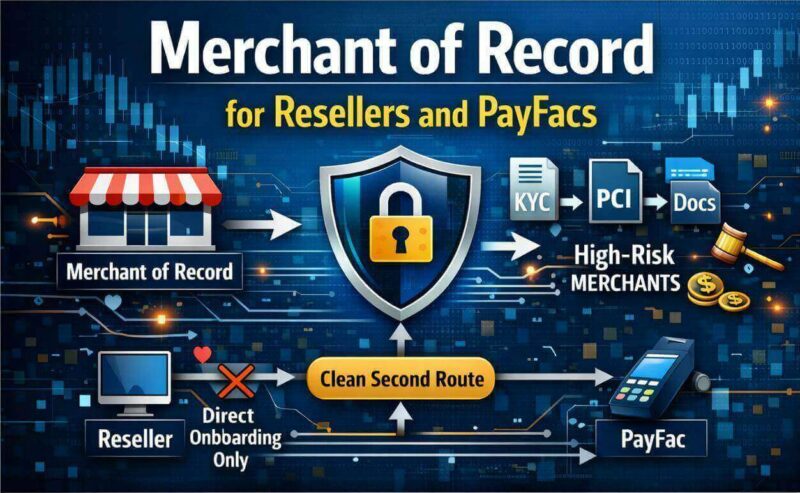
This is exactly where a Merchant-of-Record model becomes practically relevant for resellers and PayFacs. Once a merchant is rejected in the direct acquirer setup, the market often treats the case as burned. What usually follows are the bad reactions: continuing to pitch even though the acquirer is already mentally out, making the case look artificially direct-onboarding-ready, softening the technical narrative, or losing the merchant altogether. That improvisation is the real market problem. Not because resellers or PayFacs do not know better, but because there is often no reliable second structure between direct onboarding and lost merchant.
A Merchant of Record starts exactly there. Not with looser requirements, not with a trick, and not with anything that carries a third-party-billing smell. The point is different: the merchant no longer has to be forced into a direct route for which it is not clean enough structurally, documentationally or operationally. Instead, the case is moved into another framework where merchant governance, documentation, transaction logic, operational remediation and ongoing stabilisation can be handled more tightly and more deliberately. The case is therefore not polished or disguised. It is run inside the fitting model.
For resellers and PayFacs, that is the real break point. A merchant that would be lost in the direct route no longer has to be abandoned automatically. If the commercial core is sound, the product and content are viable, and the case fails not on the business itself but on direct placement, the MoR creates a second operational option. That changes the logic completely. A case that gets stuck immediately with the acquirer becomes a case that can still go live, be managed cleanly and later, where appropriate, be developed further under tighter governance. Not because the problem is hidden, but because it is handled inside the right structure.
That is why, in this context, a Merchant of Record is not the softer solution, but the cleaner solution. Anyone currently trying to make cases look artificially direct-onboarding-ready is not working inside a robust model, but inside a workaround. A MoR does not replace one improvisation with another. It replaces improvisation with an operating structure built for exactly these situations. For readers who want the underlying model logic placed cleanly at this point, see: What is a Merchant of Record. For this companion article, the consequence is clear: a Merchant-of-Record model does not make a bad case good. It prevents a viable case from being lost only because it cannot be placed cleanly in the direct setup.
Why MIDs and APMs become strategically relevant for resellers and PayFacs under a Merchant of Record
The real lever for resellers and PayFacs is not only finding a way to keep a rejected merchant alive somehow. The strategic lever is that isolated lost cases can become a governable edge portfolio. This is exactly where MIDs and APMs become relevant. If a reseller or PayFac provides a Merchant of Record with the appropriate acquiring route, MIDs and supporting APMs, the result is not just a technical connection. It creates a new structural layer in the book: merchants that would fall out of the direct model remain economically within the reseller’s or PayFac’s environment, while running operationally inside a framework the acquirer is more willing to carry.
For resellers and PayFacs, this is a different idea from classic introducing business. Normally, the case ends where the merchant cannot be placed directly with the acquirer. At that point, the outcome is either loss or improvisation. Under a MoR, the logic shifts. The merchant no longer sits outside the funnel; the merchant can continue inside a separate and more tightly governed portfolio. That is the key point. Not every merchant needs its own direct route in order to remain commercially worthwhile. In many cases, it is enough for the merchant to operate under the right operational roof, with the provided MIDs and APMs being used exactly where they make structural sense.
For resellers and PayFacs, this changes their own position in the market. Anyone who can only offer direct placement remains dependent on every single no from the acquirer. By contrast, anyone able to move cases under a Merchant of Record into a dedicated edge portfolio stops being a petitioner for one-off approvals and becomes a more relevant structural player in the setup. Not because requirements become softer, but because the cases no longer have to be forced one by one against the direct route. The value creation then sits not only in bringing merchants to the table, but in building a portfolio that remains viable even where direct onboarding ends.
A model like this does not work on argument alone. It requires a credible operating backbone: routing, payout logic, integration capability, merchant governance and the ability to run such a portfolio cleanly. The way that framework is structured at Netfield Media is shown here: payment infrastructure for creators and platforms. For resellers and PayFacs, the consequence is clear: MIDs and APMs are not just sales assets. Under a MoR, they become the instrument through which lost direct cases can be converted into an economically relevant and cleanly governed edge portfolio.
Why Merchant of Record is the cleaner alternative to improvisation and grey-zone workarounds
In the market, the real risk often does not begin with the merchant itself, but with what happens after the acquirer rejection. That is exactly where many reseller and PayFac structures drift into unclean solutions: cases are technically rebuilt, narratives are polished, gateway setups are described in softer terms, or merchants are presented as more direct-onboarding-ready than they really are operationally. Those constructions may help in the short term to get a case placed somewhere after all. Over time, however, they create exactly what neither acquirers, nor risk, nor compliance want to see: additional opacity.
For resellers and PayFacs, this is not a theoretical concern. Anyone who keeps losing merchants in the direct route comes under pressure to find alternatives. That is where improvisation becomes dangerously attractive. The case must not be lost, so the presentation, routing or formal classification gets adjusted until it somehow fits. The problem is obvious: the merchant does not become more stable as a result. It is only packaged differently. Risk is therefore not moved into a cleaner structure, but into a dirtier one. And that is exactly the point at which short-term business turns into structural weakness.
A Merchant-of-Record model is the cleaner alternative in this context because it does not rely on concealment, but on clear structure. The merchant no longer has to be artificially pushed into a direct route for which it is not operationally suited. Instead, the case is moved into a model built precisely for this kind of situation: with tighter merchant governance, cleaner documentation logic, controlled transaction handling (auth-capture-cycle) and clear allocation of responsibility. The difference is fundamental. Improvisation tries to make a case look better than it is. A MoR runs the case inside a framework in which it becomes operationally more sustainable.
That is why, for resellers and PayFacs, Merchant of Record is not the softer solution, but the more professional one. Anyone who depends on improvisation today because there is no credible second structure between direct onboarding and losing the case is, in reality, working against their own model. A MoR does not replace one workaround with another. It replaces provisional handling with a framework that acquirers are more likely to accept professionally, because what enters the book is not a raw merchant left unmanaged, but an operationally governed case. That is the real value: not circumvention, but order at the exact point where the market otherwise starts to bend the rules.
Conclusion: Merchant of Record for Resellers and PayFacs
For resellers and PayFacs, the decisive question is not whether a merchant gets placed directly with the acquirer, but whether a rejected case is therefore truly worthless. This is exactly where the market gets it wrong. Many merchants do not fail on the business itself, but on direct placement. Anyone who treats those two things as the same will lose cases that could still be viable under a different structure.
That is exactly why a Merchant-of-Record model is not the softer option in this context, but the cleaner one. It does not replace improvisation with new improvisation, but with structure. Not every rejected merchant is lost business. Many merchants have simply landed in the wrong model. Once that is understood properly, acquirer rejections are read differently — and a reseller or PayFac stops building only sales and starts building a durable model.
FAQ on Merchant of Record for Resellers and PayFacs
Does the merchant remain in the reseller’s or PayFac’s portfolio?
Yes. If the MoR sits with the reseller or PayFac, the merchant logically remains inside that portfolio. Otherwise, the model makes no economic sense.
Why are MIDs and APMs strategically important in this model?
Because the result is no longer a one-off case, but a manageable edge portfolio. When resellers or PayFacs provide the MoR with MIDs and APMs, merchants that would otherwise fall out of the direct setup remain inside their own commercial environment.
Does a reseller or PayFac lose importance by using a MoR?
No. Quite the opposite. Without a MoR, the case ends with the next acquirer no. With a MoR, the merchant remains governable inside the reseller’s or PayFac’s own model. That does not make them smaller. It makes them more relevant.
Is Merchant of Record a way around KYC, PCI or acquirer requirements?
No. A MoR is not circumvention. It is a different operating structure. Anyone turning it into circumvention has not understood the model.
What kind of merchants is this model for?
For merchants that are commercially viable, but not cleanly placeable in the direct setup. Not for garbage cases. Not for fraud. Not for constructions someone just wants to push through somehow.