The auth-capture-cycle in high risk payment is not a technical side note and not material for soft, generic payment explainers. This is exactly the point where it becomes visible whether a setup merely accepts transactions or actually controls the payment flow operationally. Most merchants understandably work with direct SALE. They want to sell, secure liquidity, run campaigns, push their product forward and not build a payment organisation on the side. That is exactly the point: a merchant is a merchant, not a structure for risk control inside the live payment flow. A merchant does not build operational logic for what a transaction may turn into one, two or five days later. A merchant does not manage reversal windows based on product type, content type and later escalation behaviour. In high risk, that exact gap becomes dangerous.
Because later damage often does not come from the spectacular exception, but from ordinary daily reality. A subscription kept running. A booking was duplicated. A top-up is only questioned later. A payment does not become visible in the moment itself, but afterwards, at home, in the bank view or in a family context. Anyone who fully completes every transaction in such situations may get funds earlier, but at the same time removes the only operational window in which a case can still be taken cleanly out of the wrong track before capture. And that window often decides later whether a case disappears quietly or returns as a refund, dispute, chargeback and ratio-relevant issue.
That is why the auth-capture-cycle in high risk payment is not a detail behind checkout, but a risk-control layer in the machine room. Not as theory and not as a polished process graphic, but as the practical question of whether a setup is even capable of recognising later conflict patterns early and intercepting them cleanly before completion. That is also why this logic applies not only to standard credit card payments, but equally to Apple Pay and Google Pay when the same operational payment logic runs underneath. And that is exactly why this section of the payment flow often says more in practice about the quality of a high-risk structure than any interface, integration or sales promise that comes before it.
Many merchants still simply run SALE in high risk
SALE is not so common because it is operationally the strongest solution. SALE is common because it is the most obvious one from the merchant’s point of view. A merchant wants to sell. A merchant wants to see conversion moving. A merchant wants liquidity. A merchant wants to run campaigns, buy traffic, test offers, organise support and keep the business moving forward. A merchant does not want to build a payment organisation with its own risk logic on top of that. That is exactly why direct SALE becomes the default reflex for so many merchants. The transaction runs through immediately, funds arrive earlier, and at first glance the process looks clean, fast and commercially reasonable. From a standard merchant mindset, that is understandable.
The problem starts when this understandable merchant logic is mistaken for good payment logic. SALE is not a mark of quality. In many setups, SALE is simply the compression of thinking into the earliest possible cash event. What gets ignored are the exact cases that never stay theoretical in high-risk operations. Not every payment is the same. Not every product creates the same customer reaction. Not every content type carries the same dispute tendency. Not every customer action has the same probability of turning later into a refund, dispute or chargeback. And yet in many merchant environments, all of these differences are pushed through the same narrow pipe: immediate sale, immediate capture, deal with the aftermath later. That is not control. That is the postponement of a problem into a more expensive phase.
It has to be said clearly: a normal merchant does not have the time, staffing model or technical structure to manage these differences properly inside the transaction flow. A merchant may look at refund rates, support tickets or recurring complaints. A merchant may notice when friction increases. But that still does not create real operational control inside payment. For that, something else is required: the ability to think product types, content categories, usage patterns, dispute probabilities and later scheme consequences together as one operational system. That is exactly what many setups do not do. Single pay, subscriptions, top-ups, impulse-driven use, more sensitive content, recurring billing, later family-driven questions or simply forgotten transactions end up being treated almost the same, even though operationally they create completely different trails.
In high risk payment, that is not just imprecise. It is dangerously crude. Because the later damage often does not come from one spectacular exception, but from the accumulation of small avoidable everyday situations. The customer realises the next day that a subscription kept running. A booking was triggered twice. A top-up only feels questionable afterwards. A payment is noticed at home and only then becomes a discussion. In a simple SALE setup, the operational window is often already gone by then. The transaction has run, the funds have been taken in, and everything that follows moves into the more expensive and more ratio-relevant direction: refund, dispute, chargeback, escalation. That is exactly the point that many merchants understandably do not prioritise from their side, while in the machine room it often decides whether a setup is strong or weak.
That is why SALE in high-risk operations is so often not wrong, but too crude, too short-sighted and too one-dimensional. It rewards speed, but ignores controllability. It brings funds in earlier, but often removes the chance to resolve smaller cases cleanly before capture. It looks efficient on merchant level, but on system level it can multiply exactly the cases that later damage ratios, trigger monitoring and create pressure on the entire acquiring structure. A merchant is allowed to think in revenue and cashflow. A resilient high-risk structure also has to think in reaction windows, reversals, ratios and scheme consequences. And that is exactly why so many merchants work with SALE, even though in high-risk payment SALE is often not the strongest logic.
3, 5 or 7 days are not a scheme detail, but controlled dispute windows
In high risk payment, an auth/capture cycle only has value if it is not set blindly the same way for everything. That is exactly where simple payment acceptance ends and real operational control begins. Anyone who treats all transactions with the same time window acts as if all products, all content types and all customer reactions ultimately follow the same track. That is not true in practice. A single pay behaves differently from a subscription. A subscription behaves differently from a top-up. And a top-up in a sensitive environment behaves differently again from a one-off, clearly recognisable payment. Anyone who ignores those differences is not simplifying. They are cutting operational reality away.
That is exactly why we do not work with one rigid capture point, but with different time windows depending on product type, content type and expected dispute behaviour. The real operational question is not: how do we bring funds in as fast as possible. The real operational question is: how likely is it that a transaction may still turn, be questioned or should be resolved cleanly before capture during the first days? That is exactly where the staging comes from. With a classic single pay, a shorter window is often enough because the typical conflict pattern is narrower. Those cases are more often about accidental duplicate bookings or immediate uncertainty that becomes visible quickly. With a subscription, the picture is different. A customer often does not realise in the same moment that cancellation should have happened, that a renewal continued or that the ongoing charge is only consciously noticed afterwards. With top-ups, the pattern often becomes even more sensitive. There, memory gaps, later questions and a higher probability that the transaction is only challenged afterwards all play a bigger role.
This does not create a rigid doctrine. It creates operational logic. 3 days, 5 days or 7 days are not cosmetic backend settings. They are reaction windows. A tighter window for single pay makes sense when dispute risk typically becomes visible earlier. A medium window for subscriptions makes sense when customer reactions often arise only after a short delay. A longer window for top-ups makes sense when experience shows that more cases only surface or get discussed afterwards. On top of that, the content of the site itself matters. Not every content type triggers the same customer perception, the same likelihood of later questions or the same escalation pattern. A properly controlled setup therefore does not only differentiate by payment type, but also thinks in content context.
One point matters here: this is not an invitation to enter three numbers somewhere and pretend that risk is being managed. The point is not the number itself. The point is the ability to derive the time window from real behaviour. Anyone who takes that seriously does not only look at transaction categories, but at patterns: When do customers reach out? Which cases later turn into refunds or chargebacks? Which usage is more impulsive? Where is the probability higher that a transaction only becomes a problem at home, on the bank statement or in a family context? That is exactly where payment leadership begins. Not at the polished checkout, but at the question of how precisely or how crudely a setup maps operational reality at all.
That is why in high-risk payment we do not run one uniform sale logic for everything, but different auth/capture windows depending on dispute profile. This is not an academic model and not a luxury. It is the practical answer to the fact that different transaction types create different later tracks. Anyone who manages those differences properly does not gain theory. They gain a real control window. And that window often decides later whether a case can still be resolved quietly before capture or whether it only becomes visible once it has already arrived inside the system as a refund, dispute or ratio-relevant issue.
Reversal before capture prevents unnecessary refunds and later chargebacks
The real value of a controlled auth-capture-cycle does not show up in the authorisation itself, but in what can still be cleanly stopped before capture. That is exactly where early correction separates from later rework. As long as a transaction has not been captured yet, a complaint does not automatically have to become a fully completed payment that then has to be collected back afterwards through refund, dispute or chargeback. A properly used reversal removes a case from the wrong track before that track builds volume at all.
In high-risk payment, this is not a cosmetic detail. It is operational hygiene. If a customer reaches out shortly after authorisation, the system situation is different from what it is after full capture. At that point, the question is no longer how to repair a completed charge afterwards, but whether the transaction ever has to move into that later conflict logic in the first place. This is exactly where reversal is stronger than refund. Refund is already post-processing on a transaction that has fully run. Reversal is intervention before completion. On paper the difference may look small. Operationally it is fundamental.
This becomes especially clear in the typical daily cases. A duplicate booking. A forgotten subscription. A top-up questioned later. A payment that only becomes visible at home and then escalates. In a simple sale setup, the operational window is often already closed at that point. The transaction has fully run, the funds have been taken, and everything that follows moves into the more expensive, slower and more ratio-relevant direction. With an open auth window, the order is different. The case can be intercepted before an irritating charge turns into a completed event with downstream consequences.
That is exactly why reversal before capture does not only prevent unnecessary refunds, but often later chargebacks as well. Not because every conflict disappears, but because many smaller cases are never pushed into the next escalation stage to begin with. That is the operational core. In the machine room, the question is not how elegantly a case can later be explained. The question is how many cases ever need to run fully through the system even though they could have been cleanly stopped beforehand. And that is exactly the point where crude payment acceptance separates from real control.
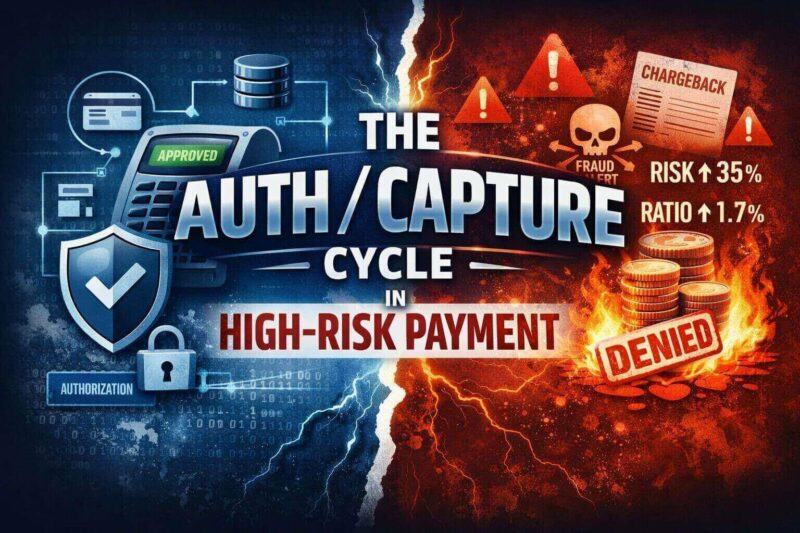
VAMP and MMP ratios are not protected only once the chargeback appears
You do not protect VAMP and MMP only once the chargeback is already on the table. At that point, you are late. Anyone who looks at ratios only at the end of escalation is already operating in the most expensive, slowest and most unpleasant phase. In high-risk payment, ratio protection starts earlier. Much earlier. Not at the point of visible damage, but at the smaller transaction types that later become visible damage if they are not controlled properly first.
That is exactly where the auth/capture cycle matters. A forgotten subscription, a duplicate booking, a top-up questioned later or a payment that only becomes visible at home is not a major case on its own. In aggregate, these are exactly the things that become dangerous. Not because every single case escalates, but because many smaller cases can build the exact volume that later deteriorates VAMP and MMP ratios. Anyone collecting those cases back only after full capture creates unnecessary downstream damage. Anyone removing them cleanly beforehand protects ratios at the point where those ratios are actually built.
That is the operational core: ratio damage is not created only at chargeback stage. It is created before that. Chargebacks are often only the visible endpoint of a chain that started much earlier. That is exactly why it is too short-sighted to treat VAMP and MMP only as late reporting issues. In the machine room, the question is how many smaller cases ever get the chance to turn into refunds, disputes and later chargeback volume at all. Anyone controlling that well does not only reduce support load, but thins out the exact track that later becomes uncomfortable on scheme and acquiring side.
That is why a controlled auth/capture cycle in high-risk payment is not a technical refinement, but direct ratio hygiene. Not every complaint can be prevented. Not every conflict disappears. But every case removed cleanly before capture does not unnecessarily load VAMP and MMP. That is the difference between reacting later and controlling earlier. And that is why protection of sensitive ratios does not start only once the damage becomes officially visible, but where it can still be operationally avoided.
The same logic applies to credit cards as well as to Apple Pay and Google Pay
The operational core does not change just because a different button appears at the front of checkout. Apple Pay and Google Pay change the customer-facing side, but they do not automatically change the auth-capture logic underneath. That is exactly the important point. Many people talk about wallets first in terms of convenience, faster checkout or better conversion. That is not wrong. But in the machine room, the more relevant question is different: Do those payments run on the same operational payment logic as standard credit card transactions or not? If they do, then the same control logic applies there as well.
That is exactly why the auth-capture-cycle is not only a topic for classic card payments. When Apple Pay and Google Pay run on the same processing layer, the same questions apply to wallet transactions: how dispute-prone is the case, how large should the reaction window be, where is a tighter window enough and where is a longer one justified, when is a clean reversal before capture stronger than later refund rework? The operational foundation remains the same, even if the frontend feels different to the customer.
That matters for the later evaluation because wallets are often read too quickly as a pure checkout topic. In reality, their real strength only becomes interesting once they are embedded into the same controlled payment logic as credit cards. Then the issue is not only less friction on the device, but the same ability to manage cases cleanly before capture, set dispute windows deliberately and thin out later ratio damage early. That is exactly why this article does not end with cards and why the wallet discussion should not begin with marketing. Apple Pay and Google Pay are different payment paths on the customer side. In the machine room, they remain part of the same operational control question.
This kind of control does not belong in normal merchant day-to-day business
A normal merchant can run sales, product, customers, support and growth. But a merchant cannot manage the same payment flow on the side as if they were already a high-risk payment organisation. That is exactly where the break starts. Once someone has to set capture windows by dispute tendency, read content context against later escalation patterns and remove small daily cases from the system before they become ratio-relevant downstream damage, normal merchant day-to-day business has already been left behind.
This is not a theoretical distinction. It is an operational one. A merchant inevitably thinks first in revenue, conversion, liquidity and customer experience. The control behind it must also think in reaction windows, reversals, escalation chains, ratio hygiene and acquiring-side consequences. That second logic cannot be attached cleanly to checkout as a side task. Anyone trying to do that builds a sales channel at the front and a blind spot at the back. And that blind spot is exactly where unnecessary refunds, disputes, chargebacks and pressure on the whole setup later come from.
That is why this form of control does not belong in normal merchant day-to-day business. Not because it is optional, but because it reaches too deeply into the machine room to run as a side task. A merchant remains strongest when the merchant remains a merchant. Everything beyond that, once it requires real control inside the payment flow, needs a structure built specifically for it. We have described that structural answer in more detail here: Merchant of Record High Risk Payment.
This is exactly where the value of specialised high-risk and MoR structures begins
This is exactly the point where the illusion ends that a normal merchant can survive high risk with a checkout, a PSP setup and some goodwill. They cannot. Once the payment flow has to be managed instead of merely processed, a normal merchant setup is structurally no longer enough. Anyone who has to control products, content context, dispute patterns, reaction windows, ratio pressure and acquiring-side consequences at the same time does not need a “nice payment partner.” They need a structure built precisely for that job.
From the acquiring side, this is not academic. It is daily survival logic. An acquirer does not need more volume that starts fraying into refunds, disputes and chargebacks at the first signs of friction. An acquirer needs a counterparty that manages volume before it breaks. That is why the real question is not whether a merchant can technically process payments. The real question is whether the setup behind those payments catches conflicts early, thins out downstream damage and keeps sensitive ratios clean. We explain that acquiring-side logic in more detail here: Merchant of Record for High-Risk Acquirers.
The same applies to resellers and PayFacs. Once merchants need more than routing and a frontend, pure pass-through stops having operational value. At that point, the issue is no longer connectivity, but consolidation, control, upstream filtering, risk discipline and real intervention capability. That is exactly where a merely connected merchant separates from a structure that can actually carry a high-risk payment flow. We explain why that matters so much for these models here: Merchant of Record for Resellers and PayFacs.
So the point is not that merchant-of-record is convenient. The point is that this level of operational depth has to be anchored somewhere properly. If it is missing, the front end keeps selling while the damage starts stacking up behind it. If it is present, conflicts are intercepted earlier, volume is managed more cleanly and the structure remains sustainable. That is why merchant-of-record in high risk is not decoration, not comfort and not sales material. It is the clean answer to a problem normal merchant structures cannot solve on their own. We explain that structural core here: Merchant of Record High-Risk Payment.
Conclusion: Auth-Capture-Cycle in High Risk Payment
The auth-capture-cycle in high risk payment is not a technical topic for PSP slides, and not a process step that gets configured once in a backend and then forgotten. It shows whether a setup merely accepts payments or actually manages the payment flow. This is exactly where crude sale logic separates from real operational control. Anyone who completes everything immediately gets funds earlier. Anyone who manages high risk properly first asks which transactions may still turn, which conflicts usually become visible only later, and at which point a case still has to be removed from the system before capture.
That is why this article was never about definitions, but about the machine room. Single pay is not subscription. Subscription is not top-up. Credit cards are different from Apple Pay and Google Pay on the customer-facing side, but underneath they often raise the same control question. And small daily cases are not harmless just because they look small. In high risk, these are often exactly the cases that later create refunds, disputes, chargebacks and pressure on VAMP and MMP ratios if no one managed them properly beforehand.
So the real point is brutally simple: ratio protection does not begin at chargeback stage. Clean payment leadership does not begin in reporting. And stable high-risk structures are not built by letting a merchant sell at the front while hoping at the back that things will somehow hold. They are built where the period between authorisation and capture is not pushed through blindly, but managed deliberately. That window is not a side issue. It is the moment where payment acceptance turns into operational control.
And that is also where the real truth behind the MoR question sits. A merchant of record is not strong just because it calls itself one. It is strong only if there is real payment infrastructure and operational leadership behind it that can actually deliver this kind of control. That means not only billing, contractual coverage and technical connectivity, but real intervention capability before capture, clean differentiation by product type, content context and dispute risk, ongoing ratio hygiene and a setup that can take conflicts out of the flow early. That is how you tell whether an MoR merely passes payments through or actually carries high-risk payment. We have described separately what that kind of resilient payment infrastructure actually looks like here: Payment Infrastructure.
That is why the auth/capture cycle in high-risk payment is ultimately more than a process step. It is proof of whether real payment leadership exists behind a setup. And it is also the point where it becomes visible whether a merchant of record is just sales material or actually has the operational infrastructure required to handle high risk in practice.
FAQ: Auth-Capture-Cycle in High Risk Payment
Is later capture not a cashflow disadvantage?
Yes, it is. Funds arrive later. In high risk, however, that is usually a much smaller price than unnecessary refunds, later disputes, rising ratios and pressure on the whole setup.
Is it not enough to manage chargebacks well later on?
No. Anyone reacting only there is already working in the most expensive phase. Clean control starts earlier, not at the end of escalation.
Can any merchant simply run this kind of cycle alone?
In theory, partly. In practice, this topic shows exactly why normal merchant business and real payment leadership are two different things.
Is this relevant only for especially problematic cases?
No. In high risk, the smaller daily cases often make the real difference. Not the one spectacular case, but the accumulation of avoidable ones.
How do you recognise whether a provider can really do this?
Not by slides, but by operational depth: intervention before capture, clean differentiation by product type and dispute risk, ratio hygiene and real payment infrastructure.