A Merchant of Record for high-risk acquirers becomes relevant wherever merchant portfolios do not merely carry risk, but consume a disproportionate amount of resources in day-to-day operations. In high-risk payment environments, these portfolios rarely fail only once a case escalates. In many cases, they fail much earlier — on volume, onboarding effort, ongoing monitoring burden, and on merchants that may be commercially accepted but are never run in a way that meets the standards required by risk, compliance and scheme-related oversight. Not every merchant is too small for revenue, but many are too small for the amount of review, documentation, remediation and control work they continuously generate.
A second point is just as important and is often underestimated in high-risk acquiring: many merchants are merchants, but not payment organisations. In practice, they often lack the documentation quality, the process discipline and the operational resilience required for sensitive high-risk portfolios. This affects not only files and review processes, but also PCI-adjacent requirements, clear responsibilities and the control of authorisation, capture and ongoing risk remediation. For acquirers, the result is familiar: onboarding consumes resources, problematic portfolios consume even more, and the operational burden ends up exactly where it is economically least attractive — inside the acquirer’s own risk, compliance and monitoring functions.
This is precisely where a Merchant-of-Record model becomes operationally relevant. Not as a sales construct, not as a workaround and certainly not as anything that resembles third-party billing, but as a controlled operating model for merchant portfolios that become disproportionately expensive, ratio-sensitive or operationally unstable in a conventional setup. For acquirers, the key question is therefore not only whether a merchant can be boarded. The real question is under which conditions a portfolio remains controllable over time without forcing effort, revenue and risk to drift apart.
What a Merchant of Record actually takes over in high-risk payment environments
In high-risk payment, a Merchant of Record does not mean “more payment processing.” It means more operational responsibility. That distinction matters. A MoR is not relevant in this context because it can technically process transactions. It becomes relevant because it can govern merchant portfolios at a depth that ordinary merchant operations regularly fail to sustain. This means governing a portfolio under real operating conditions: with documented accountability, reliable merchant documentation, clear escalation logic, ongoing remediation and transaction handling that does not wait until anomalies have already surfaced in monitoring, scheme metrics or internal risk queues.
This is exactly where many outside day-to-day operations think too superficially. Formally boarding a merchant is not the achievement. The real work starts after that. The relevant question is whether a merchant portfolio can actually be run in a way that does not force risk, compliance and acquiring teams to compensate for the same structural weaknesses over and over again. A properly run Merchant of Record model in high-risk payment consolidates that operational burden where it belongs: not in theory, but in daily execution. It creates a framework in which merchant-related obligations do not remain loosely distributed between merchant, acquirer and internal teams, but are governed through clear accountability. The broader thematic context is here: Merchant of Record in high-risk payment.
This goes beyond documentation in the narrow sense. A Merchant of Record assumes operational control over a portfolio. That includes the quality of files, responsiveness to anomalies, evidentiary discipline under ongoing requirements, the stability of process chains and the ability to prevent merchant-side weaknesses from simply being pushed upstream to the acquirer. In sensitive portfolios, that is the real distinction: a merchant is not merely boarded, but governed. Not merely accepted, but controlled. Not merely commercially attractive, but made operationally sustainable.
For an acquirer, that distinction is what matters. In this model, a Merchant of Record is not a vague intermediary role, and certainly not anything that resembles third-party billing. It assumes the operational discipline that makes a sensitive portfolio viable in the first place. That is why a MoR in high-risk environments is not a sales vehicle, but a governance structure for merchant portfolios that would otherwise drift into the same recurring patterns: weak evidentiary standards, blurred accountability, delayed remediation and internal workload ending up with the wrong party.
Why conventional merchant setups reach structural limits in risk, compliance and process discipline
The weakness of conventional merchant setups is not that they are inherently wrong. The weakness is that they are designed for ordinary merchant operations, not for portfolios where risk, compliance, monitoring and ongoing remediation become part of the operating model itself. This is where many acquirers make the same mistake: a merchant may be formally boardable and still remain operationally unsuitable. Accepting a merchant says very little about whether that merchant can actually be governed properly once it is live in the portfolio.
In practice, the pattern repeats itself again and again. Onboarding is completed, files are collected, checks are documented, and responsibilities are recorded somewhere. Formally, the merchant is now in the system. But the real burden starts after that. Many merchants are built around sales, product, campaigns and revenue, not around ongoing payment discipline. They think in conversion, not in monitoring. They think in sales, not in ratio-sensitive control. Documents are provided when requested, but rarely with the consistency, quality and response speed that a sensitive high-risk portfolio requires over time.
That is where the conventional setup begins to fail. Not at the surface level, but in day-to-day operations. Evidence exists, but is not robust enough. Responsibilities are defined, but not maintained cleanly under real pressure. Irregular patterns are not contained early, but only addressed once they are already creating internal strain. PCI-adjacent requirements, merchant documentation, escalations, remediation cycles and operational follow-ups then stop running in one disciplined line and instead turn into recurring additional work inside the acquirer. What is not managed consistently on the merchant side almost always ends up inside risk, compliance or operations.
There is also an economic error that conventional merchant setups regularly underestimate. A small or fragmented merchant often creates not little work, but disproportionately high work. Onboarding consumes resources, remediation consumes more, and the ongoing oversight burden remains high anyway. The merchant may be small in volume, but not small in internal cost. That is why high-risk payment cannot be assessed only through technical processability or formal boardability. The real question is whether the setup still holds under pressure: in documentation, escalations, anomaly handling, merchant governance and ongoing process discipline.
Conventional merchant setups therefore do not reach their limit because they lack technical capability. They reach their limit because they are usually not organised to govern a sensitive portfolio tightly enough. And that is the critical point for acquirers: not whether a merchant passes onboarding, but whether the resulting portfolio remains controllable, evidentially robust and operationally sustainable over time. For readers who want the broader conceptual frame, see: What is a Merchant of Record.
When small or fragmented merchant portfolios become economically unstable in acquiring
In high-risk payment, the problem with small or fragmented merchant portfolios rarely sits in one individual merchant. The real issue appears where internal reality no longer matches the revenue logic of the portfolio. On paper, a portfolio may still look acceptable: manageable merchant count, existing volume, no single position appearing immediately alarming. In day-to-day operations, however, a different truth emerges. The portfolio keeps generating new friction because it no longer runs like a portfolio, but like the sum of many small cases that repeatedly have to be touched again internally.
That is where the economic imbalance begins. A portfolio does not become misaligned only once losses are visible or individual cases escalate. It tips earlier — at the point where internal re-engagement, repeated effort and operational rework become structurally larger than the amount of sustainable business the portfolio actually supports. At that point, the economics are already wrong. The mistake is not that small merchants are inherently unattractive. The mistake is the assumption that small merchants automatically create small internal burdens.
For acquirers, this is a portfolio-governance issue, not a matter of instinct. A long-tail portfolio becomes economically wrong once the same internal loops start running again and again: new plausibility check, new follow-up, new documentation request, new operational classification. The work does not end once the merchant is accepted; that is where it often starts in serial form. What still appears tolerable in isolation becomes expensive in aggregate. And in high-risk environments, that aggregate is what matters. It is not one merchant that destabilises the portfolio, but the ongoing repetition of small weaknesses, small gaps and small remediation cycles.
There is another practical point that is often underestimated: fragmentation erodes governability. The more granular a portfolio becomes, the harder it is to run it with the same calm discipline as a more concentrated book. Not because each merchant is critical in itself, but because each deviation can trigger the same review path, the same internal attention and the same operational energy. The organisation then stops working on a portfolio and starts working on constant re-entry. That is the moment when volume stops creating scale and starts producing the opposite: a book that absorbs more internal governance than it should economically justify.
For risk, compliance and operations, this shift is particularly visible because it never stays abstract. It shows up in portfolios that never truly settle. Files have to be pulled back in. Classifications are reopened. Irregularities do not disappear; they return in a different form. Processes do not run through cleanly; they require continuous correction. At that point, the real problem is no longer one merchant. It is a portfolio that no longer creates internal relief. It consumes attention — continuously.
That is why, in high-risk acquiring, a long-tail portfolio cannot be assessed only by revenue or formal boardability. What matters is whether the portfolio remains governable with a proportionate level of effort. A portfolio may still look commercially valid while already being operationally wrong. Once small or fragmented merchants repeatedly reactivate the same control apparatus, the threshold to economic imbalance has been crossed. At that stage, it is no longer a healthy long tail, but a portfolio whose internal cost structure no longer matches its external revenue logic. That is the point where an acquirer can no longer look only at business, but has to look at the portfolio’s operational truth.
How compliance outsourcing works in practice for acquirers without diluting the acquiring model
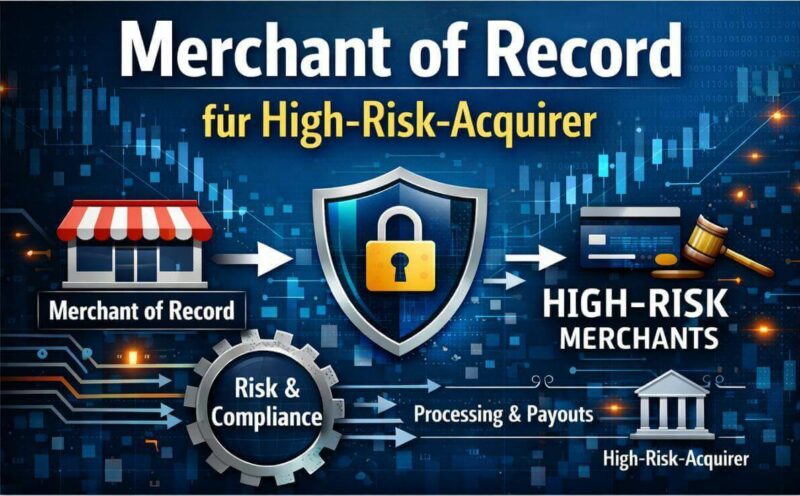
Compliance outsourcing is often misunderstood in high-risk acquiring. It does not mean that an acquirer “hands away” responsibility or steps out of the risk picture. It means that operational burden is concentrated where it is actually created inside the portfolio. That is the practical distinction. From the acquirer’s perspective, a sensitive merchant portfolio remains fully relevant, but the ongoing merchant governance, documentation discipline, remediation of irregularities and day-to-day stabilisation of the book are no longer left loosely distributed across several parties. They are governed inside a structure built specifically for that type of operational load.
In practice, this is not a cosmetic shift. It is a different operating logic. The acquirer remains the acquirer. It does not lose market access, nor its role in the model. What changes is the question of who actually carries the operational density of a sensitive portfolio. That is exactly where a properly run Merchant-of-Record model becomes relevant. It does not absorb “compliance” in the abstract. It absorbs the part of daily work that repeatedly creates the same internal pressure in problematic portfolios: incomplete evidentiary standards, inconsistent merchant governance, delayed remediation, weak response chains and books that require more oversight than a normal setup can reasonably sustain.
For acquirers, this is therefore not a fallback model, but a form of operational relief with clear accountability logic. A portfolio does not become manageable simply because it has been formally boarded. It becomes manageable once the daily work around documentation, plausibility checks, merchant control and anomaly handling sits where it can be governed with enough intensity. That is where compliance outsourcing begins in the real sense: not as a shift of responsibility into a grey zone, but as a more precise allocation of operational responsibility inside a controlled model.
This matters particularly in high-risk payment because many portfolios do not fail on one isolated rule, but on permanent instability in day-to-day execution. A merchant book becomes internally expensive when the same themes keep returning: evidence gaps, operational follow-ups, unclear classifications, remediation under time pressure, lack of discipline on the merchant side. As long as that work remains trapped inside the acquirer’s own apparatus, not only does the burden grow, but so does the structural misallocation. In that sense, compliance outsourcing does not mean “less control.” It means more control in the right place.
The same logic becomes visible in sensitive creator and platform models. A portfolio does not become stable merely because it is technically connectable. It becomes stable when merchant or sub-merchant structures are operationally governed in a disciplined way. For readers who want to go deeper into that operating layer, see payment infrastructure for creators and platforms. The underlying logic remains the same: the acquirer keeps its model, while the operational burden is moved to the point where it can be governed rather than merely processed.
Why standard sale logic is often insufficient for sensitive portfolios and why managed auth-capture matters for VAMP and MMP exposure
In high-risk payment, operational quality is not defined only by whether a transaction can be processed. It is defined by how that transaction is managed. This is exactly where the standard logic used by many merchants becomes too shallow. Running transactions straight through as sale may be the simplest process path, but for sensitive portfolios it is often not the right one. In those environments, it is not enough to think in terms of authorisation and settlement alone. What matters is how transaction patterns, remediation options and scheme-relevant metrics develop across the live portfolio.
This is not a theoretical distinction. It is a distinction in operational control. Many merchants rely on standard sale not because it is the best logic from a payment perspective, but because they are merchants, not payment organisations. They often do not have the process structure, discipline or operational control needed for finer transaction steering. For an acquirer, that creates a structural problem: the portfolio may appear transaction-capable on the surface, while internally it runs on a logic that is too coarse for a sensitive book. That is why, in high-risk environments, it is not enough to look at transaction acceptance alone. The real question is whether the transaction logic fits the risk and monitoring profile of the portfolio.
This is where managed auth-capture becomes relevant. Not as a technical footnote and not as an optimisation trick, but as part of operational risk control. Once the time between authorisation and final capture is deliberately governed, more changes than just the payment flow of an individual transaction. The governability of the portfolio itself changes. In that sense, a five-day auth-capture cycle is not a marketing claim, but a sign of a different operating logic: transactions are not merely accepted, but managed under ongoing observation and with awareness of downstream risk and monitoring effects. That is precisely what many conventional merchants cannot sustain in day-to-day operations.
For risk, compliance and acquiring teams, this is therefore more than process design. In sensitive portfolios, transaction steering can have direct relevance for VAMP- and MMP-related anomalies, ratio-sensitive thresholds and the question of how early problematic patterns become visible or containable. A pure sale logic often means reacting only once irregularities are already embedded in the book. A deliberately governed authorisation-capture model provides earlier operational leverage. That is the difference between simple transaction processing and active portfolio governance.
For acquirers, this is the point at which a Merchant of Record in high-risk payment becomes operationally intelligible. Not because a MoR means “more payment,” but because it can sustain a transaction logic that often does not exist in ordinary merchant operations. A sensitive portfolio requires more than acceptance. It requires governance. And one of the clearest signs of that governance is whether transactions are merely pushed through or actually managed.
Liability shielding in practice: where a specialised Merchant of Record reduces the acquirer’s operational burden
Liability shielding in high-risk payment does not mean that risk disappears. It means that risk is governed before it reaches the acquirer, with earlier containment, tighter handling and cleaner operational control. That is where the real relief sits. A sensitive merchant portfolio does not become more stable simply because problematic patterns are formally recorded. It becomes more stable when irregular transaction behaviour, merchant-side weaknesses and operational deficiencies do not flow unfiltered into monitoring, risk, compliance and scheme-related escalation.
For acquirers, this is not an abstract benefit. It is a question of the impact intensity inside the live portfolio. Without a specialised governance structure, the same themes keep landing directly inside the acquirer’s own apparatus: problematic developments, ratio-sensitive patterns, weak merchant governance, remediation under pressure and portfolios that generate more escalation than they economically justify. A Merchant of Record in high-risk payment does not change the existence of risk. It changes the operational line before that risk reaches the acquirer. Problematic developments are picked up earlier, governed more tightly and prevented from becoming visible only once they have already entered ratios, internal queues or externally relevant thresholds.
This matters especially in portfolios exposed to VAMP and MMP pressure. In those environments, the key issue is not only whether irregularities exist, but when they are identified, where they are operationally absorbed and how they are contained before hardening into a more damaging pattern inside the acquirer model. That is how liability shielding works in practice: not as a claim that risk has somehow been “taken away,” but as operational pre-filtering, tighter merchant governance and earlier escalation control. The objective is not to soften risk rhetorically, but to prevent merchant-side weaknesses from turning into scheme-related or internal pressure in an unfiltered way.
For risk and compliance leaders, the relevance comes down to a simple question: where does the problem hit first? In an ordinary setup, often directly inside the acquirer. In a specialised MoR model, ideally earlier, closer to the source and with greater operational density in the upstream governance of the portfolio. That is where liability shielding becomes a credible operating principle: not pretending risk is gone, but intercepting it before it hits the acquirer.
Conclusion: Merchant of Record for High Risk Acquirers
In high-risk payment, sensitive merchant portfolios do not usually fail because they cannot be processed formally. They fail because they are being run under an ordinary merchant setup even though they require a different operating logic. Once acquirers, risk and compliance can only keep a portfolio stable at disproportionate effort, once auth-capture, documentation discipline, monitoring, and VAMP- or MMP-sensitive patterns require tighter control, the decisive question is no longer whether the merchant is boardable. The decisive question is whether the portfolio is still being run in the right model.
That is exactly where a Merchant of Record in high-risk payment becomes the appropriate model. Not as a marketing promise, not as a billing construct, and not as a workaround, but as the structure for portfolios that require more operational governance than ordinary merchant logic can provide. If a portfolio remains stable only through tighter merchant governance, more controlled transaction logic and earlier containment, then Merchant of Record in high-risk payment is not the alternative model, but the logically correct operating model.
FAQ on Merchant of Record for High-Risk Acquirers
Is Merchant of Record in high-risk payment a model for isolated cases or for entire sensitive portfolios?
A Merchant of Record in high-risk payment is not relevant only for isolated problematic cases. It becomes relevant where entire portfolios can no longer be governed cleanly under ordinary merchant logic. The key issue is not whether a merchant can be formally accepted, but whether a portfolio remains stable across risk, compliance, monitoring, documentation and operational remediation. Once that is no longer the case, a conventional merchant setup is no longer sufficient.
How do acquirers recognise that a portfolio is running in the wrong model?
Usually not through one incident, but through a pattern. Onboarding absorbs resources, follow-up requests do not stop, irregularities reappear, merchant documentation remains unstable, and small or fragmented books keep activating the same internal control apparatus. At that point, the issue is no longer one difficult merchant. It is a portfolio being run in the wrong operating model.
Why is a normal merchant setup often insufficient in high-risk payment?
Because many merchants generate revenue, but do not bring resilient payment discipline. That is where the real problems begin: weak documentation, delayed remediation, simple sale logic instead of controlled transaction handling, and portfolios that generate more internal work than they can economically justify. In high-risk payment, the decisive issue is therefore not only whether a merchant can sell, but whether the merchant can be governed cleanly under continuous scrutiny.
What role do auth-capture, VAMP and MMP play in practice?
A very direct one. In sensitive books, it is not enough to let transactions simply pass through as sale. What matters is whether the period between authorisation and capture is actively governed. That is why a managed auth-capture cycle matters in VAMP- and MMP-sensitive portfolios. It changes not only the payment flow, but the question of how early problematic patterns become visible and containable.
Does liability shielding mean that the acquirer no longer carries risk?
No. Liability shielding does not mean that risk disappears. It means that risk is picked up earlier, governed more tightly and operationally pre-filtered before it hits the acquirer, risk or compliance functions in an unfiltered way. The difference lies not in denying risk, but in the escalation logic and in the first operational line that governs the portfolio.
When is Merchant of Record in high-risk payment the right model?
Merchant of Record in high-risk payment is the right model when a portfolio remains stable only through tighter merchant governance, stronger documentation discipline, more controlled transaction logic and earlier containment of irregularities. At that point, the question is no longer whether MoR is an optional add-on, but which model is still operationally sustainable for the portfolio.