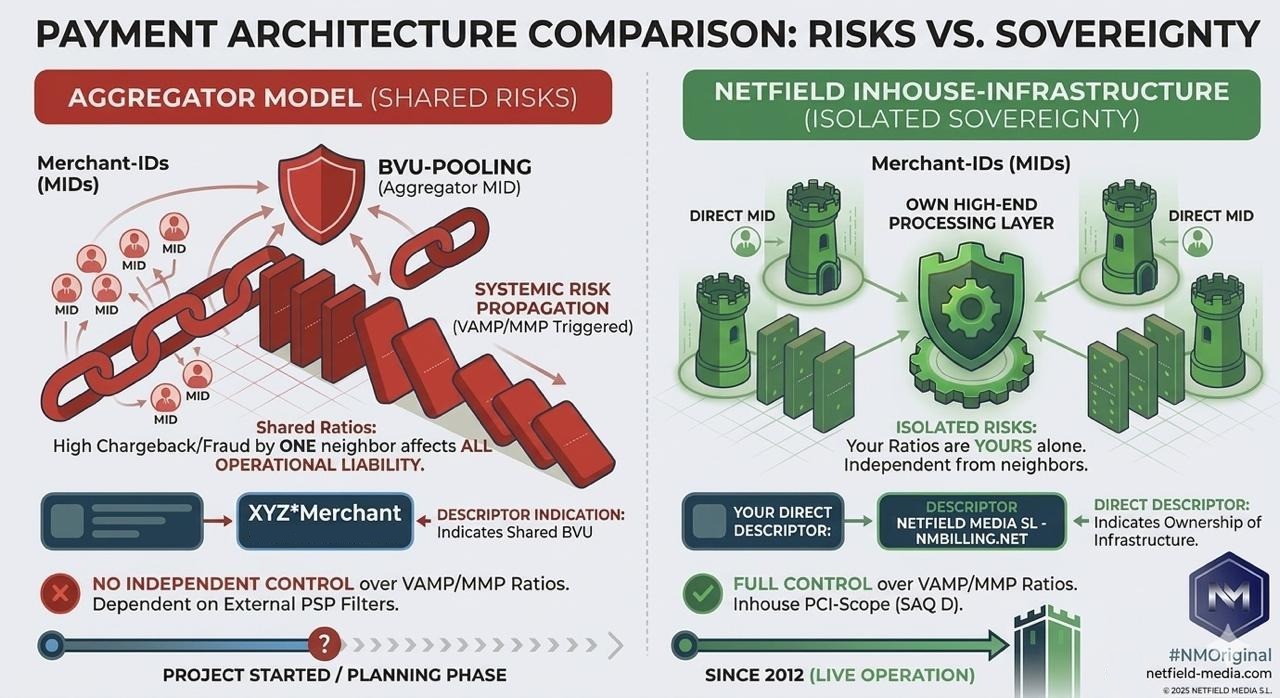
PCI DSS Compliance has never been an easy topic for ordinary merchants. Since April 1, 2025, it has turned into a real structural problem in many cases. For years, many merchants in digital content convinced themselves that SAQ A, a redirect to a PSP, or a formally outsourced card flow meant the issue was largely solved. In practice, that logic was often weak even before. Once ASV scan obligations started hitting day-to-day reality, the old model broke down for good. This is where a lot of people are forced to face what they ignored for too long: PCI DSS Compliance is not really a normal merchant topic. It is an infrastructure topic.
The core problem is not that merchants are careless. The problem runs deeper. A merchant sells services, subscriptions, memberships, or digital content. A merchant is not built to run a hardened card payment architecture, define PCI scope cleanly, provide external vulnerability scans, control script integrity, document responsibilities across the payment flow, and keep that structure stable in front of acquirers, scanners, and compliance stakeholders over time. That is why so many setups fail not because of a missing form or a missing certificate, but because the wrong role is carrying the burden.
Anyone processing card payments for digital content today has to start with an uncomfortable truth: there is no path around PCI DSS Compliance. The real question is no longer how to downplay it, hide it technically, or mentally outsource it through third parties. The real question is which structure can actually carry the weight. That is where Merchant of Record starts. Not as an excuse, not as a label, and not as a sales phrase, but as a clean response to a problem that ordinary merchants often cannot solve properly on a technical, operational, and regulatory level.
Why PCI DSS Compliance is not a manageable day-to-day topic for ordinary merchants
On paper, PCI DSS Compliance is often presented as just another payment requirement. That is also how many merchants hear it: set things up, fill out a few forms, connect the PSP properly, document it once, and move on. Real card processing does not work like that. Not in digital content, not with recurring payments, not with international flows, and certainly not in setups where checkout, routing, risk, acquiring, and technical responsibility are not cleanly separated.
The mistake usually starts early. A normal merchant assumes the job is to sell products or services and buy payment capability from a provider. That sounds reasonable, but in card environments it is only half true. The moment a merchant operates in a structure where its own website, scripts, redirects, processes, or decisions shape the card flow, PCI DSS Compliance is no longer just an external attachment. At that point, it is tied to the merchant’s own environment, its own exposure, its own attack surface, and its own ability to keep that environment under control over time.
That is where merchant reality and payment reality split apart. A merchant is built around sales, product, customers, conversion, content, retention, and revenue. A merchant is not built to harden a card environment, define scope properly, control technical changes, provide external vulnerability scans, maintain structured evidence, and hold that line so consistently that acquirers, scanners, and compliance stakeholders do not immediately start pulling on the next loose thread. This is not a moral judgment. It is simply the wrong base role.
That is why so many ordinary merchants do not fail on one isolated PCI point. They fail on the overall structure. The obligation exists, but the operating model does not fit. That contradiction is exactly what later produces the usual illusion that PCI DSS Compliance can somehow be minimized, mentally pushed onto the PSP, or talked away through a neat onboarding story. In reality, that does not solve the problem. It only postpones it until the structure breaks against reality.
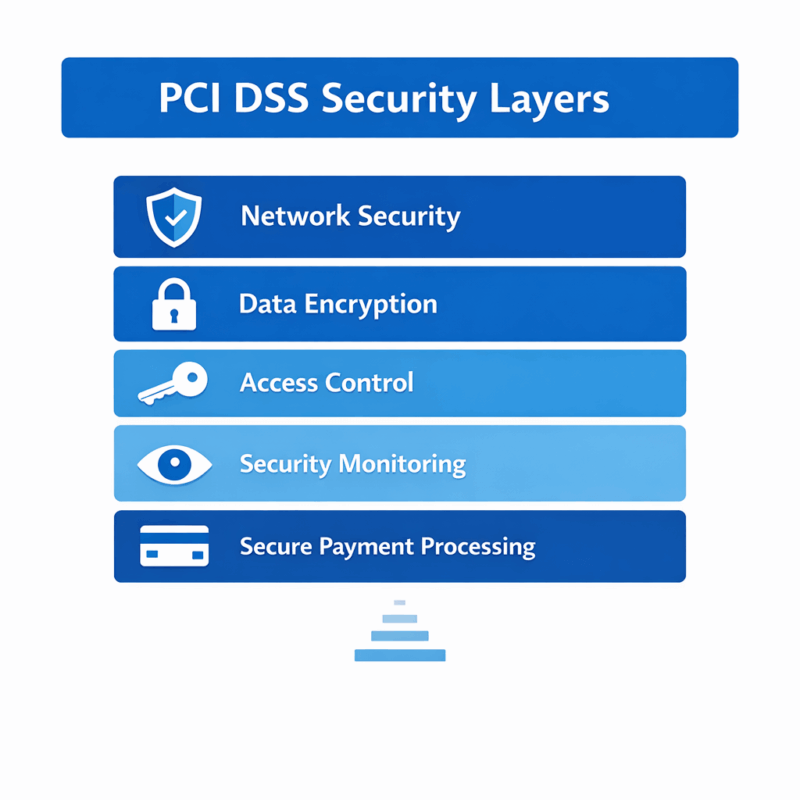
Network Security → Data Encryption → Access Control → Security Monitoring → Secure Payment Processing
Merchants are merchants, not payment infrastructure
This is where the real construction error sits. An ordinary merchant is not built to carry PCI DSS Compliance as a permanent infrastructure process. A merchant sells products, services, subscriptions, or digital content. The organization is built around marketing, conversion, customer service, content control, and revenue. It is not built to operate a security-relevant card environment in a way that remains technically, operationally, and regulatorily stable over time.
In practice, that boundary gets blurred all the time. As long as the discussion stays at the level of “we connected a PSP” or “an external provider handles the cards,” many merchants still assume the topic is manageable. The problem starts where the merchant structure does more than just sell. The moment its own pages, checkout components, redirects, scripts, or internal flows shape the card flow, the role begins to shift. At that point, this is no longer just commerce. It is already part of payment infrastructure.
That is exactly what many people misread. A merchant can of course accept payments. But that does not mean the merchant structure is also suited to carry the underlying card environment cleanly over time. PCI DSS Compliance does not require only good intentions and a few documents. It requires control depth, technical stability, clean scope definition, traceable responsibilities, and an environment that still holds up when examined closely. That is no longer normal merchant logic.
This contradiction becomes visible very quickly in digital content. Payments there often run in environments with recurring billing, international reach, sensitive acceptance issues, higher risk, and a much tighter connection between checkout, conversion, and payment logic. In that kind of setup, it is not enough that some external provider sits somewhere in the chain. The real issue is whether the payment role sits in the right structure at all. And that is where the line becomes clear: merchants are merchants. Payment infrastructure is something else.
There is still no way around PCI DSS in card processing
For years, many merchants held on to the same story: connect a PSP, add a redirect, outsource the payment page, and PCI DSS Compliance is basically no longer their problem. That story was dangerous even before. Today it is unusable. Anyone running card processing does not move outside PCI just because an external provider appears somewhere in the chain. Credit-card processing remains a control-heavy environment. A PSP does not change that. A gateway does not change that. A clean-looking onboarding slide does not change that.
The core mistake is always the same. People act as if the PCI question is already answered the moment a third party is technically involved. In reality, that is where the real examination starts. The decisive point is not whether a provider is involved, but how the flow is built, who shapes it, and where the security-relevant responsibility actually sits. The moment merchant-side systems, owned pages, checkout components, redirect logic, embedded scripts, or other controlled elements influence the payment flow, the issue has not disappeared in any elegant way. PCI DSS Compliance is still there, only now often in a form that is less understood and therefore more dangerous.
That is why so many market statements are wrong. “Our provider is PCI compliant.” “We only use hosted payments.” “We are just redirecting.” “The cards do not run directly through us.” Those phrases may sound reassuring to merchants, but they do not answer the decisive question. The decisive question is not whether an external provider exists in the setup. The decisive question is whether the merchant’s own structure is truly outside the security-relevant role or whether it still shapes the card flow in a way that keeps PCI DSS Compliance tied to the merchant’s real environment.
In digital content, this self-deception is especially dangerous. Card flows there are rarely simple. Recurring billing, international users, sensitive acceptance conditions, conversion pressure, risk-driven decisions, and close technical proximity between frontend and payment logic all make it much harder to talk responsibility away. Anyone processing credit cards in that environment no longer has an awareness problem. They have a structure problem. That is exactly why the question “How do I get around PCI?” points in the wrong direction. The right question is: In which structure is PCI properly carried?
Why since April 1, 2025, most old SAQ A constructions have been breaking on ASV scans
The real break did not happen gradually. It became visible. For years, many merchants leaned on the same comfortable construction: SAQ A, a redirect to the PSP or gateway, maybe a formally outsourced payment page, and with that the belief that PCI DSS Compliance had been reduced so far that it no longer had to be carried seriously in day-to-day operations. That world broke in practice on April 1, 2025.
That old logic has been practically broken since April 1, 2025, because once the effective PCI requirements and ASV scans apply, it becomes visible whether the setup is truly durable or only built on an SAQ A narrative.
The reason is not theoretical. It is brutally practical: ASV scans. As long as merchants believed they could “organize away” card processing through a slim SAQ A story, the real strength of many setups could remain hidden behind clean wording. The moment external vulnerability scans have to be presented, that comfort ends. From that point on, it no longer matters how nicely the setup was described during onboarding. What matters is whether the real environment is scannable, controllable, and technically structured in a way that can still support real PCI DSS Compliance.
That is exactly where large numbers of old constructions started to fail. Not because merchants suddenly became worse. But because many of those setups were never built to survive real external technical scrutiny. As long as the discussion stayed at the level of SAQ categories, it was easy to hide behind redirects, hosted pages, and third-party language. The moment ASV scans land on the table in practice, the truth shows itself. It becomes visible that owned domains, owned websites, owned reachability, owned security posture, and owned technical responsibility never actually disappeared from the picture.
That is why April 1, 2025 matters so much for this market. Before that, people could still talk themselves into believing that a merchant with an outsourced card flow had basically reduced the issue cleanly enough. Since then, that story no longer holds. The structure now has to stand up not only in language, but technically. And this is exactly where the old models collapse. Many merchants do not have a properly hardened environment. Many cannot produce stable external scan results. Many never ran a structure that was meant to withstand this level of verifiable scrutiny. That is why SAQ A plus redirect has stopped being a durable comfort formula for large parts of the market.
One point matters here: the problem is not the ASV scans themselves. The scans are simply the point where the wrong role assignment becomes visible in the open. They do not reveal a random isolated issue. They reveal the structural mistake. An ordinary merchant wanted to sell. The merchant did not want to operate a scannable, continuously controlled, security-relevant card environment. That is why, since April 1, 2025, many setups have not just lost a technical assumption. They have lost the old narrative itself. Anyone who believed PCI DSS Compliance could be kept small through a PSP redirect can now see that reality is harder than the sales story.
Merchant of Record solves the PCI problem structurally
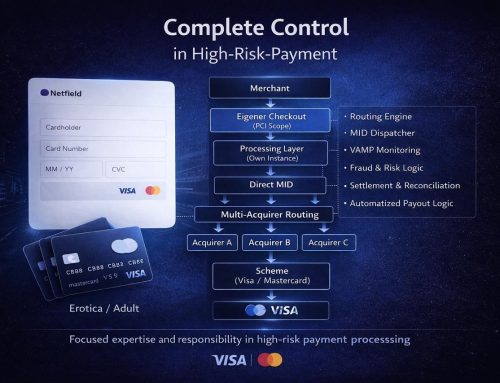
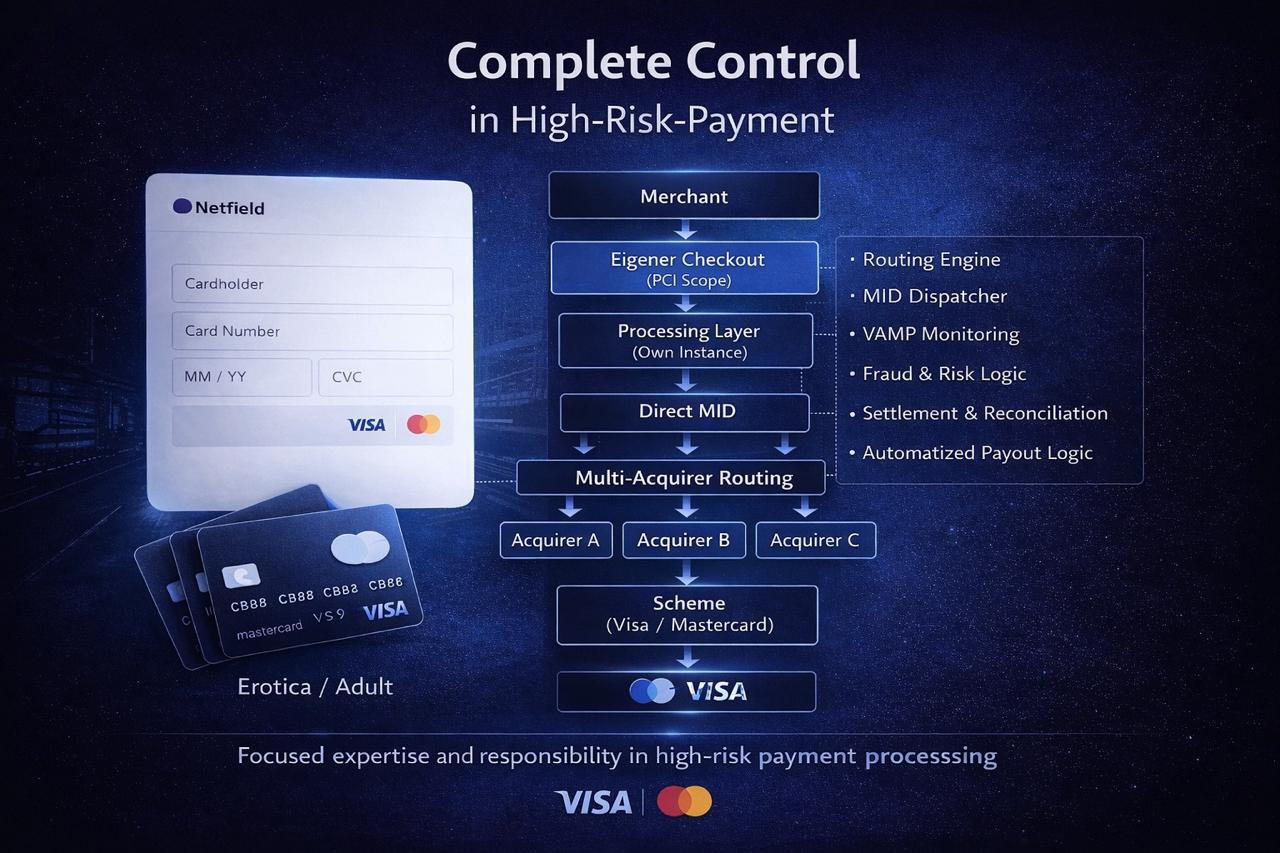
This is exactly the point the market has been getting wrong for years. Merchant of Record does not solve PCI DSS Compliance by making PCI disappear. Merchant of Record solves it by making sure PCI finally sits with the right role. That is the difference. Not less PCI. Not nicer language. Not a merchant trying to shrink the issue through a PSP, a redirect, and a bit of documentation. But a payment role placed where card processing, risk, acquiring, responsibility, and technical control actually belong together.
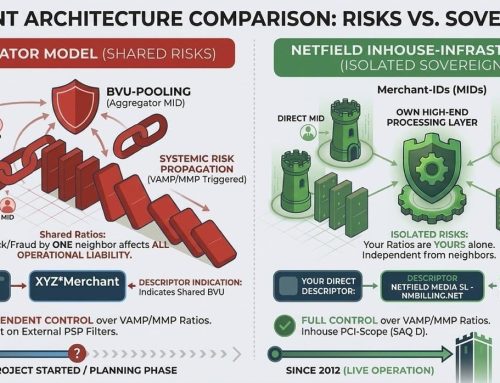
In practice, that is a hard difference. In the classic merchant setup, revenue is kept at the merchant level while the card reality is pushed as far away from the merchant as possible. That is exactly where the known breakpoints come from. The merchant is supposed to sell, but at the same time absorb scope questions. The merchant is supposed to manage content, conversion, and customer relationships, while also carrying a card environment that already behaves like payment infrastructure in operational reality. The merchant is supposed to benefit from card revenue without properly taking on the role logic that comes with it. In many cases, that construction does not hold. It only looks usable until reality starts asking harder questions.
Merchant of Record reverses that logic. The model does not pretend that an ordinary merchant can permanently carry the same burden as a structure built for payment operations. The model says: if the payment reality has already become infrastructure, then the payment role must sit inside an infrastructure structure. That is exactly why Merchant of Record is not a sales phrase and not a label for outsourced acceptance. Merchant of Record is the clean assignment of the card role to the party that is actually supposed to carry it.
This matters especially in Merchant of Record High Risk Payment settings. There, it is not enough that cards somehow work technically. Acceptance, risk, recurring billing pressure, acquiring readability, scope clarity, and PCI DSS Compliance all have to fit together. A real Merchant of Record does not solve that cosmetically. It solves it at the structural level. Not through avoidance, but through correct classification. Not by minimizing the truth, but by building a payment architecture in which the truth is finally represented cleanly.
That is why Merchant of Record is not just one option among many for digital-content setups. It is often the first structure in which PCI DSS Compliance no longer hangs inside merchant operations like a foreign body, but sits where it logically, technically, and operationally belongs. That is also why the right statement is not: “With Merchant of Record, PCI is gone.” The right statement is: With Merchant of Record, PCI is moved to the right place. And for many merchants, that is the difference between a permanent misfit structure and a durable card setup.
Merchant of Record and PCI DSS Compliance
Merchant of Record matters in the context of PCI DSS Compliance not because card rules suddenly disappear. The model matters because the payment role sits where it actually belongs in card logic. A Merchant of Record is not just some technical service provider in the background. It stands as the formal merchant in the card model, carries the payment function, takes commercial responsibility inside the flow, and runs card acceptance not as a side issue, but as its actual role. That is exactly the difference from the typical merchant logic where selling and card responsibility are artificially kept inside the same structure even though both are operationally very different things.
That is why Merchant of Record reduces the burden of PCI DSS Compliance not through softer wording, but through clear relocation. Card acceptance, acquiring, chargeback logic, risk control, technical control, and operational compliance no longer sit with an ordinary merchant that wants to sell products or digital content. They sit with an actor that is built for exactly that payment role. This is not rhetorical relief. It is structural relief. That is exactly what turns an unsuitable merchant burden into a durable payment architecture.
One point needs to stay precise. Merchant of Record does not automatically mean that every PCI question disappears completely for the connected platform or digital business in every possible setup. What still matters is how the integration is built, which systems influence the payment flow, whether owned checkout components remain security-relevant, and whether there is still contact with PCI-relevant parts of the environment. That is exactly why Merchant of Record is not a magic shortcut, but a clean allocation of roles. When that allocation is correct, the PCI burden on the merchant side drops sharply. When the integration remains unclear, the boundary remains unclear as well.
This is especially decisive for platforms, creator models, SaaS structures, memberships, and international digital business models. In those environments, the issue is not just whether payments technically go through. It is about recurring billing, international acceptance, risk, evidence, and lasting stability. That is exactly where Merchant of Record shows its strength: not as a trick, not as an outsourced button, but as a structure in which PCI DSS Compliance sits with an actor whose core function is card processing. For operating models in that space, this is the point where a fragile merchant setup turns into durable payment infrastructure for creators and platforms.
The real advantage therefore does not lie in outsourcing individual steps. It lies in the clear allocation of defined responsibility. Merchant of Record does not take over “a bit of payment.” It takes over the exact part of the business that must be carried cleanly in the card model. That is why the right statement is not: “With Merchant of Record, PCI is gone.” The right statement is: With Merchant of Record, PCI sits where card processing, risk, and control actually belong together.
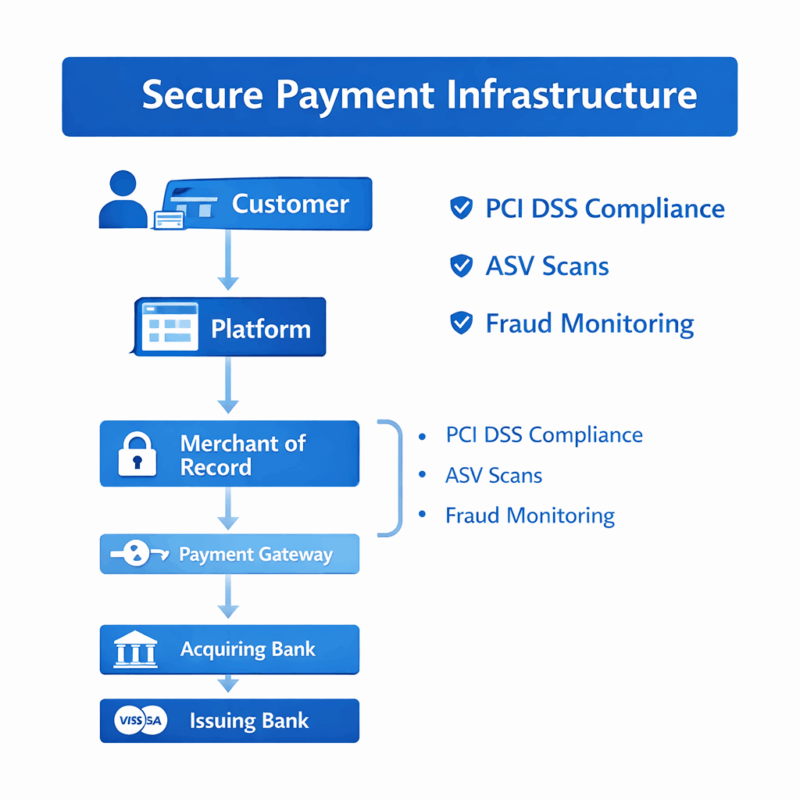
Customer → Platform → Merchant of Record (e.g. Netfield Media) → Payment Gateway → Acquiring Bank → Card Network → Issuing Bank
📌 NETFIELD MEDIA meets the requirements of PCI DSS SAQ D Merchant compliance, including the mandatory ASV scans. The verification record can be viewed here.
Merchant of Record for Resellers and PayFacs
Resellers and PayFacs do not lose bad business. They lose merchants that are not cleanly sustainable as direct cases inside a normal merchant role. That is the point. The merchant brings revenue. The merchant brings volume. The merchant brings real business. But the merchant does not bring a structure that cleanly supports PCI DSS Compliance, card logic, and long-term technical durability beyond a simple merchant picture.
That is exactly where direct cases break. Not because the merchant is worthless. Not because there is no market. But because a merchant is not an operator of durable payment infrastructure. As long as that reality is ignored, the same effect appears again and again: the business exists, but it cannot be placed cleanly as a direct case. That is exactly where resellers and PayFacs lose revenue they could otherwise keep operationally.
The wrong reaction is well known. People still try to force the case into a normal merchant structure. Not because anyone wants to soften the story, but because they want to save the business. So side paths are used, constructions are built, and classifications are shaped so that a merchant which is not cleanly direct-capable can still be made to fit a normal frame. That may keep the case moving. It does not make it stable. The core problem remains unchanged: the payment role still sits with the wrong actor.
Merchant of Record is the solution exactly for these cases. Not as a detour. Not as a rescue ring. But as the structure in which commercially good business is not lost simply because it cannot be cleanly sustained as a direct merchant case. The merchant stays in play. The volume stays in play. The business stays in play. What ends is only the attempt to make a structurally unsuitable merchant look artificially readable as a direct case.
That is exactly why Merchant of Record for Resellers and PayFacs is a real operating model, not a side route. It does not give resellers and PayFacs a softer story. It gives them a durable structure. A merchant that cannot be placed cleanly as a direct case becomes a merchant that can be run stably under Merchant of Record over the long term. Not through tricks. Not through wording. But through the right payment role.
High-risk acquirers prefer Merchant of Record models with real payment infrastructure
A high-risk acquirer prefers a properly built Merchant of Record because it does not have to review an overstretched merchant role. It reviews a payment structure. That is the difference. In a normal merchant case, in a direct case that does not truly hold, or in a bent setup built around a merchant, reseller, or PayFac, the card role sits with an actor whose real job is selling, not running actual payment infrastructure. In a Merchant of Record model, the card role sits where it belongs in high-risk payment: inside a structure that carries card acceptance, risk, chargebacks, technical control, and PCI DSS Compliance as a core function.
That is exactly why the assessment changes. A high-risk acquirer does not prefer a Merchant of Record because risk disappears. It prefers it because risk is properly carried. It does not prefer it because PCI DSS Compliance somehow stops mattering. It prefers it because PCI is structurally placed where it belongs. It does not prefer it because a merchant has been packaged more attractively. It prefers it because what it sees is not merchant retrofitting, but a card structure that is readable as a card structure. That is the point merchants, resellers, and PayFacs need to understand.
For merchants, the message is clear: anyone who does not run real payment infrastructure will never be assessed by a high-risk acquirer as if they do. For resellers and PayFacs, the message is just as clear: a merchant that is not cleanly sustainable as a direct case does not become better through side routes, intermediate constructions, or a more acceptable framing. Only the structure gets better when the payment role is moved into the right place. That is exactly why the clean line ends at Merchant of Record. Not as an escape path. Not as a fallback. But as the model that turns a hard-to-place merchant case into a durable card structure.
A high-risk acquirer immediately sees in a real Merchant of Record the points that otherwise keep breaking in the market. PCI scope is cleaner. Operational responsibility is bundled. The card function is clearly assigned. The setup does not hang loosely off a merchant that is already supposed to handle sales, content, conversion, and customer relationships while somehow carrying card logic on the side. That is exactly why something appears on the acquirer side that ordinary merchant cases often fail to create: confidence in the durability of the structure. Not confidence in wording. Not confidence in an onboarding story. Confidence in a payment architecture that still holds under pressure.
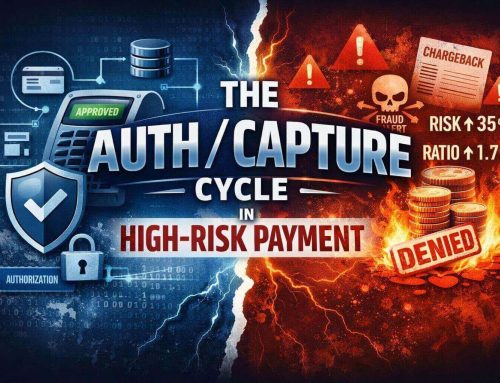
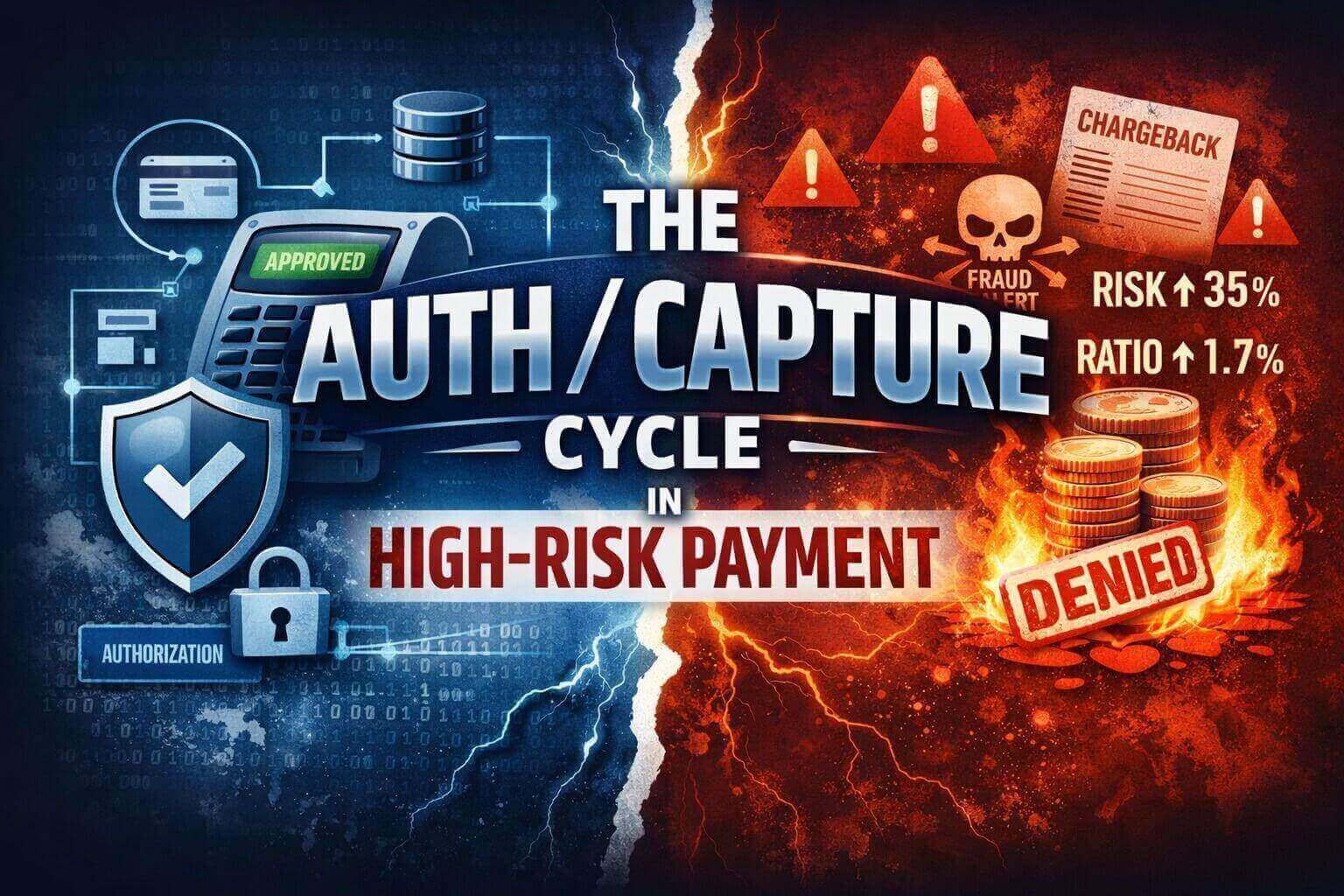
Then there is the operational point that often matters faster than any description in high-risk. An acquirer does not review paper roles only. It reviews whether the card flow is actually controlled. That is exactly why the auth-capture-cycle in high risk payment belongs here. It shows whether a model is built on contract logic alone or on real control of card processing. Auth, capture, recurring logic, chargeback handling, monitoring, and technical discipline do not look like improvised merchant add-ons in a properly built Merchant of Record. They look like controlled payment logic. That is what a high-risk acquirer values. Not because it sounds easier, but because it is operationally stronger.
That is why Merchant of Record models for high-risk acquirers are not merely easier to like. They are the cleaner decision on the merits. Payment infrastructure exists here. PCI is properly placed here. Scope is readable here. The card flow is actually run here. That is the point where it becomes obvious for merchants, resellers, and PayFacs that the right path does not lead into a bent merchant role, but into Merchant of Record.
Conclusion: PCI DSS Compliance Solved Through Merchant of Record
PCI DSS Compliance is not a problem that gets solved for unsuitable merchants through better onboarding, cleaner wording, or technical workarounds. That is where the mistake has been for years. A merchant that does not operate real payment infrastructure and cannot carry card reality properly on a technical level does not suddenly become sustainable through redirects, gateway constructions, shifted responsibilities, or other side paths. The merchant remains a merchant in the wrong role. Everything else is only delay until the next review, the next friction point in acquiring, or the next break in the flow.
That is exactly why Merchant of Record is the solution. Not as a fallback. Not as an escape model. But as the right structure for cases where the merchant is commercially good, yet not cleanly sustainable as a normal merchant. That is where merchant logic ends. That is where Merchant of Record begins. From that point on, there is no reason to keep bending the case, masking the issue, or working around the real structural question. That has to stop.
For merchants, the message is clear: If you cannot carry PCI DSS Compliance cleanly yourself, Merchant of Record is the right path. For resellers and PayFacs, the message is just as clear: If a good merchant cannot go live direct because sustainable PCI reality is missing, that merchant belongs under Merchant of Record. Not inside a distorted merchant role. Not inside an artificially adjusted construction. But inside a structure that cleanly carries card acceptance, risk, operational control, and PCI.
For high-risk acquirers, that is the clean consequence. Instead of forcing every small merchant through the same painful review just to see whether its merchant structure might somehow carry card burden after all, the better decision is obvious: Merchant of Record with real payment infrastructure, cleaner PCI scope, and a controlled card flow. That is exactly why a properly built Merchant of Record such as Netfield Media is not just easier to like, but the professionally correct answer. Less friction. Less scope fog. Less merchant improvisation. More structure. More control. More durability.
The real answer to the problem is therefore no longer: how do I still get this merchant live as a direct case. The right answer is: put the card role where it actually belongs. And once a merchant, reseller, or PayFac looks honestly at that point, the clean line always ends in the same place: Merchant of Record. Netfield Media. Real payment infrastructure instead of merchant improvisation.
The merchant is not lost. The merchant stays in the portfolio. Only the wrong merchant role ends.
FAQ: PCI DSS Compliance Solved Through Merchant of Record
Is PCI DSS solved with Merchant of Record?
No. PCI DSS is not gone. PCI DSS sits in the right place with the Merchant of Record, because that is where the card role belongs.
Why is SAQ A with a PSP, gateway, or redirect no longer enough?
Because SAQ A does not replace payment infrastructure.
Since April 1, 2025, old models have been breaking on ASV scans and on real technical structure.
Why do normal merchants fail at PCI DSS Compliance?
Because a normal merchant sells, but does not operate payment infrastructure.
PCI DSS Compliance requires more than checkout and forms.
When is Merchant of Record the right solution?
When a merchant wants card payments, but cannot carry PCI DSS Compliance, scope, and card reality cleanly on its own.
What is the clean solution for resellers and PayFacs when a good merchant cannot go live direct?
Merchant of Record.
The merchant stays in the portfolio, but no longer in the wrong merchant role.
Why do high-risk acquirers prefer a real Merchant of Record?
Because they see payment infrastructure, cleaner PCI scope, operational card control, and clear responsibility.