
Settlement Is Not a Bank Transfer. For payouts to content providers and creators, the bank transfer is only the final visible step in a process that starts much earlier. Before any payment instruction can be sent to a bank, the system must already know which revenue belongs economically to which recipient, which accounting logic applies, which amounts are currently available for payout and whether all requirements for the scheduled payout cycle have been met.
This distinction is particularly important in a Merchant of Record model. Netfield Media is the Merchant of Record. Connected content providers and creators are not merchants within the acquiring structure, nor are individual customer payments simply passed on to them. Netfield Media accounts for the revenue generated within its own merchant structure according to the applicable contractual logic and calculates the resulting payout amounts.
In operational terms, this involves much more than calculating a figure at the end of the month. Revenue allocation, accounting, rolling reserves, approvals, payout dates and bank communication all have to remain consistent. An amount may already be economically allocated to a content provider or creator while still being unavailable for the next payout. Conversely, previously reserved amounts may become eligible for release during a later settlement cycle.
The key difference therefore lies in the end-to-end automation of this process chain. At Netfield Media, a regular payout cycle is not rebuilt manually every time. Once a content provider or creator has been correctly configured and the accounting model, bank details, payout frequency and required approvals have been defined, the system continues to process recurring settlement cycles according to those rules.
Settlement therefore becomes part of the operational payment infrastructure rather than an administrative task performed after the fact. Illness, holidays or temporary staffing shortages should not determine whether a scheduled payout can be prepared.
The quality of a settlement system is not demonstrated by its ability to transfer money. It is demonstrated by its ability to turn large numbers of individual transactions into the correct, approved and technically executable payout for the correct content provider or creator, every time.
Settlement Starts Long Before the Payout Date
The payout date is not the point at which settlement begins operationally. In a reliable infrastructure, it is a predefined execution point within a process that is already running. By then, the economic allocation, accounting status, payout frequency and any restrictions must already be known to the system.
At Netfield Media, this preparation starts when the content provider or creator is correctly configured. The system knows the agreed accounting logic, the registered bank details and the scheduled payout cycle. New revenue is continuously allocated to the correct contractual partner instead of being manually collected shortly before the next payout date.
A settlement date is therefore not a signal to start processing. It is a predefined point at which the next stage of an existing process is executed.
This becomes particularly important with recurring payouts. If payments are scheduled twice per month, this does not create two new administrative tasks every month. The frequency is part of the stored settlement logic. The system already knows which positions belong to the respective cycle and which positions must remain outside it.
At the same time, different financial and operational states must remain clearly separated. Revenue may already be economically allocated without being available for the next payout. A reserve may still be held or may already have become eligible for release. A payout may be scheduled but temporarily blocked because a required approval is still missing.
These conditions should not first be discovered on the payout date.
This is one of the key differences between automated settlement infrastructure and downstream payment administration. If employees have to collect revenue figures, review exceptions, search for approvals and prepare payout lists on the due date, the process remains reactive and dependent on individual staff.
At Netfield Media, regular settlement cycles instead continue on the basis of data and rules that are already present in the system. The payout date is the result of previously running system logic, not the beginning of it.
This also creates a different level of predictability. Recurring settlement cycles can be prepared without rebuilding the operational process for every individual date. That reduces manual workload and, equally important, reduces dependence on a specific person being available at exactly the right time.
Revenue Becomes a Reliable Statement for Content Providers and Creators
Between generated revenue and an amount that can actually be paid out lies the accounting process. This is where it becomes clear whether a settlement system merely adds up figures or is capable of carrying economic positions correctly across multiple settlement periods.
At Netfield Media, revenue generated during an accounting period is allocated to the respective content provider or creator within the system and processed according to the configured remuneration logic. The important point is that the calculation does not look only at current revenue. A reliable statement must also recognise positions originating from earlier settlement cycles that become payable only now.
Rolling reserves are a clear example. An amount held in reserve remains economically allocated during the agreed reserve period, but it is not yet available for payout. It therefore has to remain identifiable as a separate position within the system. Once the reserve reaches its scheduled release point, it does not have to be located manually or transferred from a separate tracking list. It can be brought back into the appropriate later accounting cycle by the system.
This creates different economic states that must not be confused. Revenue may already have been generated and clearly allocated to a content provider while part of it remains reserved. At the same time, the same statement may include reserve amounts from earlier periods that have now become eligible for release.
The current payout is therefore not simply “revenue minus fees”. It is the result of accounting logic that continues across time.
Subsequent changes to previously processed transactions must also remain attributable to the correct economic position. Refunds or chargebacks are examples, but they are not the core of the architecture. What matters is that a later change does not force employees to reconstruct previous statements outside the system and apply manual corrections.
This continuity becomes particularly important with recurring payouts. Without a system-based history, current revenue, retained amounts, released reserves and later transaction adjustments can quickly end up in separate and inconsistent data sets.
Netfield Media keeps these positions within the same accounting logic. The underlying transaction and allocation data therefore produce a traceable statement showing the amount intended for the respective settlement cycle.
The statement is not merely a document for the content provider or creator. It is the economic link between revenue generation and the later banking execution.
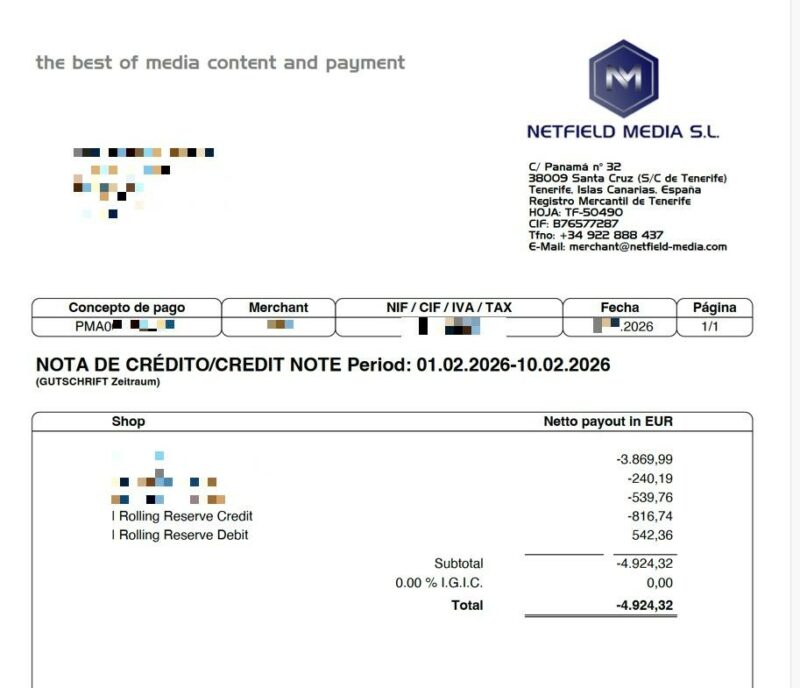
Example of a system-generated statement showing reserve positions. – Sensitive information has been redacted.
End-to-End Automation Is at the Core of the Settlement Process
Automation does not begin when a system generates a statement as a PDF or exports a payment file. If amounts still have to be checked manually, files moved between systems, payout batches assembled or individual payments released by staff, the process remains dependent on people.
At Netfield Media, the regular settlement workflow is therefore built as a connected technical chain. The economic allocation of a content provider or creator, the applicable accounting parameters, the agreed payout frequency and the relevant approval status are already available to the system. Based on this information, the statement is generated and the corresponding payout cycle is prepared for its scheduled execution date.
A regular settlement cycle at Netfield Media is not reorganised every month. It is executed by the system according to rules that have already been defined.
This makes a substantial difference in day-to-day operations. If a process depends on a particular employee opening a list on the right day, checking amounts, generating files and initiating payments, every one of those steps creates a human dependency. Illness, holidays or temporary staffing shortages can then directly affect payouts.
In an integrated settlement architecture, that should not be the normal operating model. Once a content provider or creator has been fully configured, the defined accounting and payout logic continues to operate regardless of which employees happen to be available on a particular day.
Scalability does not come from adding more people to process more payouts. It comes from processing additional settlement activity within the same system logic.
End-to-end automation does not mean removing controls. A missing regulatory approval, invalid master data or a technical error must not simply be ignored. Such conditions need to produce a defined system status and, where necessary, stop the affected transaction without turning the entire regular settlement cycle into a manual exception process.
This is where automation differs from simply making a manual workflow faster. A fast manual process is still manual. Settlement infrastructure must be able to manage calculation, status, approval and technical execution as connected states within the same process.
For Netfield Media, reducing dependency on individual employees is therefore not a convenience feature. It is a requirement for operating recurring payouts reproducibly as the number of content providers, creators and settlement dates increases.
Economic Allocation and Payout Approval Are Two Different States
A content provider or creator may already have an amount that is clearly allocated economically while that amount is not yet eligible for payout. A reliable settlement process must keep these two states separate because economic accounting and regulatory approval follow different rules.
At Netfield Media, the economic allocation therefore remains within the system even if certain requirements for the payout are still outstanding. This may occur, for example, when a required KYC or AML process has not yet been completed. The amount must then remain outside the upcoming payout cycle while still being clearly attributable to the relevant content provider or creator.
A regulatory hold must not destroy the economic allocation. It should block only the payout.
This is exactly where manual structures tend to create parallel processes. Amounts are removed from the regular cycle, recorded separately, placed on follow-up lists and later reintroduced manually into a payout. Every additional step increases the risk of inconsistent data states or of a released position becoming disconnected from the settlement cycle in which it originally arose.
Netfield Media treats this situation as a defined system state. The amount remains within the accounting logic while its payout status is blocked. Once the required approval has been obtained, the position can again become eligible for a regular settlement cycle.
This preserves a clear record of why an economically existing amount was not paid at a particular point in time and which condition must be fulfilled before it becomes payable again.
This distinction is also important for internal control. A settlement system should not only differentiate between “paid” and “not paid”. It must also retain the reason why a position was not executed. A reserve that has not yet reached its release date, a missing regulatory status and a technically non-executable payout are economically and operationally different conditions and should not disappear into a generic error state.
As the number of content providers and creators grows, this status logic becomes increasingly important. What may still be understood through personal knowledge with ten recipients must not depend on an employee remembering why a particular amount was excluded from a previous payout cycle once the operation scales.
Settlement should be able to explain the state of a position by itself.
This creates more than a controlled payout process. It allows regulatory requirements to be managed within the same infrastructure in which the underlying economic accounting already takes place.
From AEB to EBICS: Bank Files and Bank Processing
Once the statement has been completed and the payout amount for a content provider or creator has been approved, the banking execution begins. This is also the point at which the term “payout” is often used too early. An amount calculated by the system, a generated bank file and a payment instruction transmitted to the bank represent different technical states.
Netfield Media used AEB-based procedures for its bank communication for many years and moved the technical connection to EBICS and harmonised XML formats several years ago. This also brought the banking side more closely into the automated settlement process. Payment data required for a payout cycle can be generated in a structured form from the preceding accounting process and transmitted to the bank in a machine-readable format.
The distinction between the individual technical states is important. The statement determines which amount is to be paid. The bank file created from that information translates the payout cycle into a format that can be processed by the bank. EBICS provides the secure transmission to the connected banking institution. Bank-side processing starts afterwards.
A generated bank file is not yet an executed payout.
Even a technically successful EBICS transmission initially confirms that the file or payment instruction has been received by the bank. It does not automatically mean that every payout contained in the file has already reached its final processing state. This is why feedback from the bank communication is part of the same technical workflow at Netfield Media.
This distinction is more than a matter of displaying the correct status. If a system treated successful file generation or transmission as a completed payout, internal system states and actual bank processing would become mixed. A subsequent rejection or technical deviation could then leave the internal system showing a status that does not reflect what actually happened at the bank.
Settlement therefore requires a clear chain of calculation, bank instruction, transmission and feedback. Each stage has its own technical state.
For Netfield Media, this feedback loop also matters because the regular payout cycle does not end when a file is exported. Bank communication forms part of the process itself. A payout should continue through the workflow according to the processing status it has actually reached.
This again demonstrates why Settlement Is Not a Bank Transfer is more than a wording distinction. The bank transfer represents only the banking execution of an amount that has already been accounted for, approved and prepared for the relevant payout cycle.
For Netfield Media, moving from AEB to EBICS and harmonised XML formats was therefore not merely a change of file format. It was another step towards connecting accounting and banking execution within one continuous, machine-readable process.
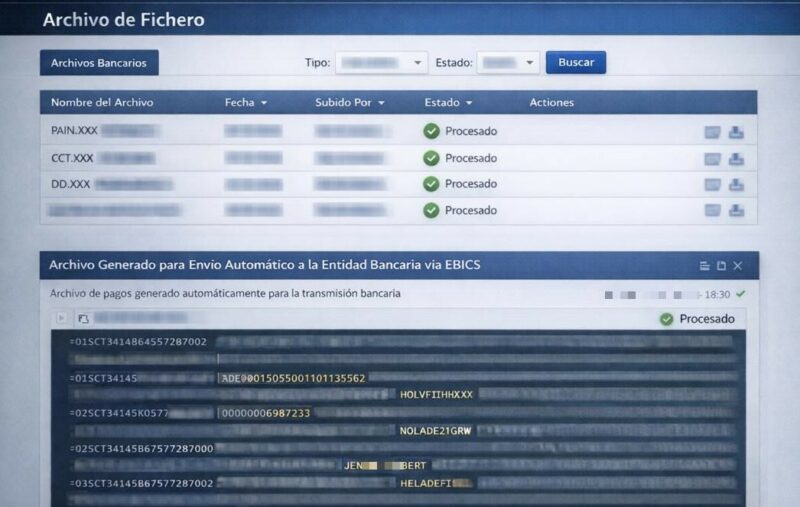
Bank files (ebics) within the automated settlement process of Netfield Media. Sensitive information has been redacted.
Automated Settlement Makes Small and Frequent Payouts Operationally Manageable
The robustness of a settlement architecture is not demonstrated only by large payout cycles. It becomes particularly visible when many different payout amounts and several execution dates have to be processed reliably.
In a manual process, every additional payout creates additional work. The amount has to be reviewed, assigned to a payout list, prepared as a banking instruction and then processed further. With small payout amounts, the administrative effort can quickly become disproportionate to the economic value of the payment itself.
The regular settlement process at Netfield Media works differently. The size of a payout does not change the underlying technical process chain. Whether a content provider or creator is due EUR 9.84, EUR 900 or EUR 9,000, the accounting, status checks, allocation to the relevant payout cycle and banking process follow the same predefined rules.
This is why Netfield Media can process payouts from as little as EUR 0.01 at system level. The important point is not the one-cent amount itself. What matters is that a small payout does not create a separate manual workflow. The system processes it within the same settlement logic used for significantly larger amounts.
The same principle applies to payout frequency. Depending on the agreed structure, content providers and creators at Netfield Media can be paid once, twice or three times per month. An additional regular payout date does not require an employee to build an entirely new second or third process.
The scheduled dates and the relevant accounting periods form part of the system logic. Each settlement cycle processes the positions eligible at that point and transfers them into the defined banking workflow.
More payout dates therefore do not automatically mean more manual settlement work.
This also matters for operational resilience. If a company has to restrict payout frequency simply because every additional cycle consumes staff capacity, its payout model is ultimately constrained by its own administration. At Netfield Media, the regular process is designed to continue according to the defined rules even when employees are on holiday, absent due to illness or temporarily required for other operational tasks.
End-to-end automation is therefore not demonstrated by the number of functions listed in a system. It becomes visible in daily operations: once correctly configured, recurring settlement cycles are processed by the system without rebuilding every individual payout as a new administrative task.
This is another reason why Settlement Is Not a Bank Transfer matters. The bank transfer itself does not distinguish between a small and a large payout. The real infrastructure lies in connecting accounting, approval, scheduling and banking execution so that both amounts can be processed within the same controlled workflow.
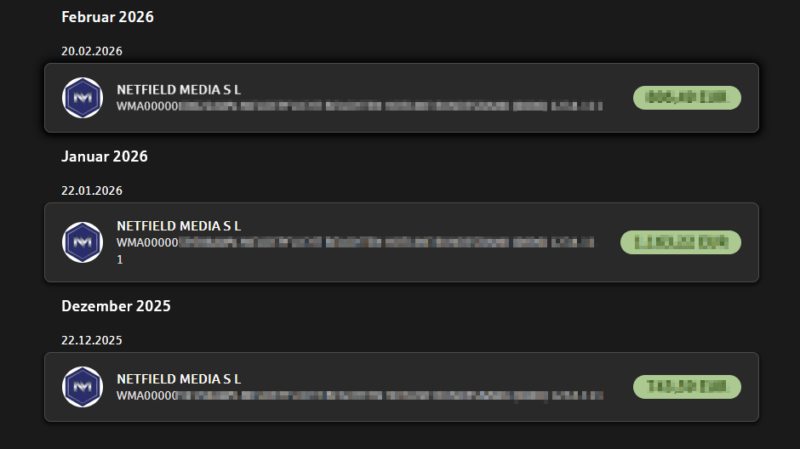
Example of recurring payouts generated through the automated settlement process of Netfield Media. Amounts and sensitive account information have been redacted.
Conclusion: Settlement Is Not a Bank Transfer
Settlement Is Not a Bank Transfer. The transfer itself is only the final banking step in a process that has already been prepared economically and technically long before the bank becomes involved.
At Netfield Media, this process starts with the correct allocation of revenue to content providers and creators. From there, the accounting statement, reserve positions and the amount actually available for a specific settlement cycle are determined. Regulatory approvals have to be respected, payout schedules have to be applied and the resulting banking instructions have to be processed technically before the payment reaches the bank.
The connection between these individual states is what matters. An economically allocated amount is not yet an approved payout. A completed statement is not yet a bank instruction. A generated bank file is not yet an executed payment. And successful transmission does not automatically mean that final bank processing has been completed.
Reliable settlement infrastructure must therefore be able to determine at any time which state an amount has reached and why.
For Netfield Media, the operational advantage lies primarily in the end-to-end automation of this chain. Regular settlement cycles are not rebuilt manually for every payout date. Once a content provider or creator has been correctly configured and the accounting logic, payout frequency and bank details have been defined, the system continues to operate according to those parameters.
This reduces dependency on staffing and allows the settlement process to remain reproducible as the number of content providers, creators and payout cycles increases. The ability to process payouts from EUR 0.01 and, depending on the agreed structure, once, twice or three times per month is not an isolated feature. It is a direct consequence of the fact that each individual payout does not create a new manual workflow.
The technical achievement is not moving money from one bank account to another. It is reliably determining which amount may be paid, when, to whom and under which conditions, and maintaining that state consistently through to bank processing.
The technical architecture behind scheduling, liquidity management, pre-execution validation and automated bank communication is explored in greater depth in the Netfield Media whitepaper “Autonomous Liquidity Management and Predictive Settlement.”
FAQ on Settlement for Content Providers and Creators
What happens if a scheduled payout date falls on a bank holiday?
A contractually or system-defined payout date does not automatically mean that banks will process payment instructions on that day. Banking days and public holidays therefore need to be considered when payout cycles are scheduled.
A reliable settlement calendar must reflect not only the contractual due date but also the banking days on which execution is actually possible. Otherwise, a payout cycle may be internally scheduled correctly while bank processing takes place later. For recurring payouts, planning these dates in advance is more robust than manually postponing individual payments afterwards.
Why is reconciliation still important after an automated payout?
Automation does not remove the need to reconstruct a payment process afterwards. The statement, the resulting banking instruction and the actual bank processing must remain clearly connected.
Reconciliation creates this link. It makes it possible, for example, to determine which payout cycle corresponds to a specific banking transaction and whether the expected technical status matches what was actually processed by the bank.
Automation answers how a process is executed. Reconciliation answers whether its different layers still match afterwards.
What happens when a content provider or creator changes bank details?
A new bank account is not just another master-data field within settlement. It changes the execution path for future payouts and should therefore be introduced into the existing process in a controlled way.
The timing of the change is particularly relevant. If a payout cycle is already being prepared or processed by the bank, old and new account details should not be mixed uncontrolled within the same execution.
Bank-detail changes therefore need a clear status and an effective point from which they apply to future payouts. This reduces the risk of a correctly calculated payout being sent through an outdated banking path.
Why should settlement not be managed through spreadsheets and individual bank transfers?
Spreadsheets may initially be sufficient for documenting amounts in very small structures. The difficulty increases as the number of content providers, payout dates and different processing states grows.
Economic allocation, approvals, bank details, reserve positions and actual payouts then have to remain synchronised. When this information is spread across several spreadsheets and manual banking operations, additional handover points are created.
The main risk is not the spreadsheet itself, but the manual handovers between accounting, approval and banking execution.
The more of these handovers exist, the harder it becomes to reconstruct a single payout completely and consistently at a later date.
Why does an audit trail matter in settlement?
An audit trail should document more than the fact that a payout occurred. It should make it possible to determine how the amount was created and which states it passed through before execution.
This can include the relationship between economic allocation, accounting, approval status, payout cycle and bank processing. In financial operations, this history becomes particularly relevant when a transaction has to be reviewed internally or explained to a contractual partner at a later stage.
A reliable audit trail therefore reduces dependency on personal knowledge. The answer to “Why was this amount processed in this way on this date?” should be derivable from the system rather than from an employee’s memory.
Why are defined settlement cycles important for content providers and creators?
A defined settlement cycle provides more than predictability for the recipient. It also structures the underlying economic and technical processes.
When regular payout dates are known in advance, accounting periods can be closed consistently and the relevant positions can be assigned to a specific cycle. At the same time, content providers and creators have a clearer expectation of when regular payouts are due.
The important point is not whether payouts occur once, twice or three times per month. What matters is that the selected cycle can be operated reproducibly and technically controlled.
How does Merchant of Record settlement differ from simply passing through customer funds?
In a Merchant of Record model, the Merchant of Record is itself the central merchant party within the sales structure. Amounts subsequently due to content providers or creators arise from the contractual and economic allocation within that structure.
This is fundamentally different from a model in which a service provider merely receives payments on behalf of other merchants and subsequently forwards their customer funds.
Netfield Media, as Merchant of Record, settles with content providers and creators within its own structure. This distinction is important both for the technical architecture and for the economic interpretation of the settlement process.