Anyone searching for payment providers for digital content often still approaches the topic through an older lens: connect payment methods, build checkout, process transactions. For many digital business models, that is no longer enough. In digital services, recurring revenue, cross-border sales and sensitive segments such as adult and other high-risk verticals, the durability of the model is no longer determined by the payment rail alone, but by the structure behind it. The real issue today is not simply who can process payments technically, but who can handle VAT, billing, settlement, risk and commercial responsibility in an operationally sound way.
This is exactly where the term payment providers for digital content becomes too vague. In practice, many companies are not looking for payment processing alone. They are trying to solve a broader structural problem: how to build digital revenue in a way that does not immediately create more tax complexity, more operational friction and more risk exposure as the business scales. Anyone evaluating the market only through the lens of a traditional PSP setup is often looking at the most visible layer, but not the decisive one. That already matters in lower-risk environments, but in high-risk digital business it is often the point where stable models separate from fragile ones.
That is why it no longer makes sense to judge payment providers for digital content mainly by checkout features, fee claims or API access. What matters is the model behind the transaction and who actually carries responsibility across the chain. This is where the difference between payment processing and infrastructure begins. And this is why the search for a payment provider increasingly leads to a deeper question: when does a Merchant of Record model offer the more resilient, more coherent and commercially sound foundation for digital business.
What companies are usually looking for when they search for “payment providers for digital content”
When companies search for payment providers for digital content, they are often not looking for a processor alone. In reality, they are trying to solve a bundle of problems that starts where the transaction begins. That usually includes recurring payments, cross-border billing, VAT, chargebacks, settlement, risk control and the question of who carries operational responsibility once a digital business starts to scale. This is why the search term is broader than what many traditional PSP structures actually cover.
This becomes especially visible in platforms, creator businesses, memberships, digital services and any model where payment cannot be treated as an isolated function. In those environments, it is not enough for a transaction to work technically. What matters is whether the setup remains stable under regulatory pressure, higher volume and more sensitive business conditions. Companies that frame this only as a payment processing question are often defining the problem too narrowly. In practice, the more relevant question is whether payment infrastructure for creators and platforms has to be designed differently so that growth does not automatically create more complexity and more operational fragility.
This is where the shift from provider language to operating model begins. Many businesses say they are looking for payment, but what they really need is structural relief, commercial clarity and responsibility across the flow. That is why the search for a payment provider in digital business often leads one step deeper: to the question of when a Merchant of Record model is the more coherent answer than a pure PSP setup — especially once subscription payments start requiring durable billing, failure handling and ongoing operational control.
Why traditional PSP models often fall short in digital content
Traditional PSP models are easy to understand at first glance. They provide technical payment processing, connect payment methods and route transactions. In standard e-commerce settings, that can be sufficient. In digital content, the reality is often very different. The operational challenge does not end with a successful authorization. In many cases, that is where it starts. As soon as recurring billing, digital fulfillment, international customers, chargebacks, tax treatment and sensitive business models come together, it becomes clear that pure processing structures solve only part of the problem.
That is the decisive distinction. A traditional PSP usually does not carry the full commercial logic behind the business. It handles the payment rail, while responsibility, tax complexity, billing consequences, chargeback pressure and a large share of the operational burden remain with the merchant. Many businesses do not see this immediately, because the weakness of these models rarely appears during onboarding. It tends to show up later, once volumes increase, markets expand or risk profiles become more demanding. At that point, the gap between “payment technically works” and “the business is operationally sound” becomes difficult to ignore.
This matters even more in segments where digital products are not only sold, but continuously operated, scaled internationally and exposed to higher risk conditions. In adult and other demanding digital verticals, this is exactly why the question is no longer just which provider can accept payments, but which model can actually support the business in a stable way. We explored that shift in more detail in Adult payment is now an infrastructure question. Anyone relying only on a traditional PSP logic in these environments is often building on a setup that works technically, but remains too narrow on the operational level.
That is why it is not enough to evaluate payment providers for digital content by API access, fee claims or payment method coverage alone. What matters is whether the underlying structure can truly support digital distribution, recurring revenue and more demanding risk profiles. In areas such as adult payment and high risk payment, this distinction is not abstract. It is operationally decisive.
Merchant of Record instead of payment processing alone
As soon as digital business models move beyond isolated one-off transactions, payment processing alone is no longer the decisive layer. This is where the difference between a traditional PSP setup and a Merchant of Record becomes relevant. A PSP processes payments. A Merchant of Record takes on a much broader share of the commercial and operational structure behind them. Depending on the model, that can include billing, tax handling, responsibility across the transaction flow and the ability to support digital business not only technically, but structurally.
In digital content, this is not a theoretical distinction. Businesses selling digital services internationally, running recurring revenue or operating in more sensitive segments often reach the limits of a pure PSP logic in ways that were not visible at the beginning. The issue is usually not checkout itself, but the model behind it. That is why the question of Merchant of Record has become more relevant for many companies than the question of the next payment feature. A clear foundation for that distinction can be found here: What is a Merchant of Record.
For anyone searching for payment providers for digital content, this is a decisive point. Many providers cover the technical side of the transaction, while the real operational burden remains with the merchant. A Merchant of Record model changes exactly that logic. It does not simply replace a processor. It changes how digital revenue is carried from an organizational, tax and operational perspective. That is why MoR is no longer just an additional term in the payment market. For many digital businesses, it is the more accurate answer to a problem that the term “payment provider” describes only incompletely.
Digital content, high-risk business and adult verticals now require infrastructure
With digital content, the quality of a payment setup is rarely proven by the first successful transaction. What matters is whether the model remains stable once billing, risk, international reach and day-to-day operations start interacting at the same time. This is exactly where traditional PSP structures often become too limited. They solve the technical acceptance of payments, but not automatically the operational reality behind digital business models. Companies working with recurring revenue, platform logic, ongoing digital services or more sensitive verticals therefore need more than processing. They need a structure that does not only enable the business technically, but can support it properly in live operation.
This shift becomes especially visible in high-risk segments and in the adult sector. In those environments, several pressure factors hit at once: stricter acceptance conditions, more tension around billing and approval rates, more sensitive risk decisions, higher demands on operational stability and far less tolerance for structural weakness. That is exactly why it is no longer enough to treat payment in these markets as an isolated provider question. Anyone focusing only on which provider can technically route payments is defining the issue too narrowly. The real question is which model remains durable under real market conditions without leaving the full operational weight with the merchant.
This is where adult, erotic and other sensitive digital verticals make something visible that also applies more broadly to digital business: payment is no longer just about checkout, API access or payment method coverage. It is a question of infrastructure, allocation of responsibility and structural resilience. Businesses scaling in these categories need a setup that does not run into new limits every time another country, another billing layer or another shift in risk exposure enters the picture. This becomes especially clear where micropayments for adult content only remain viable when fee logic, bundling and model structure actually fit the economics of very small transactions.
How to recognize durable payment infrastructure
You do not recognize durable payment infrastructure by the number of payment methods it offers, the polish of the checkout or the speed of technical integration. Those are entry requirements, not proof of structural quality. In digital content, the real stress test always begins after the first successful transaction. What matters is whether the model remains stable once recurring billing increases, more countries come into scope, tax requirements become more complex, support cases grow or the business starts operating under sharper risk conditions.
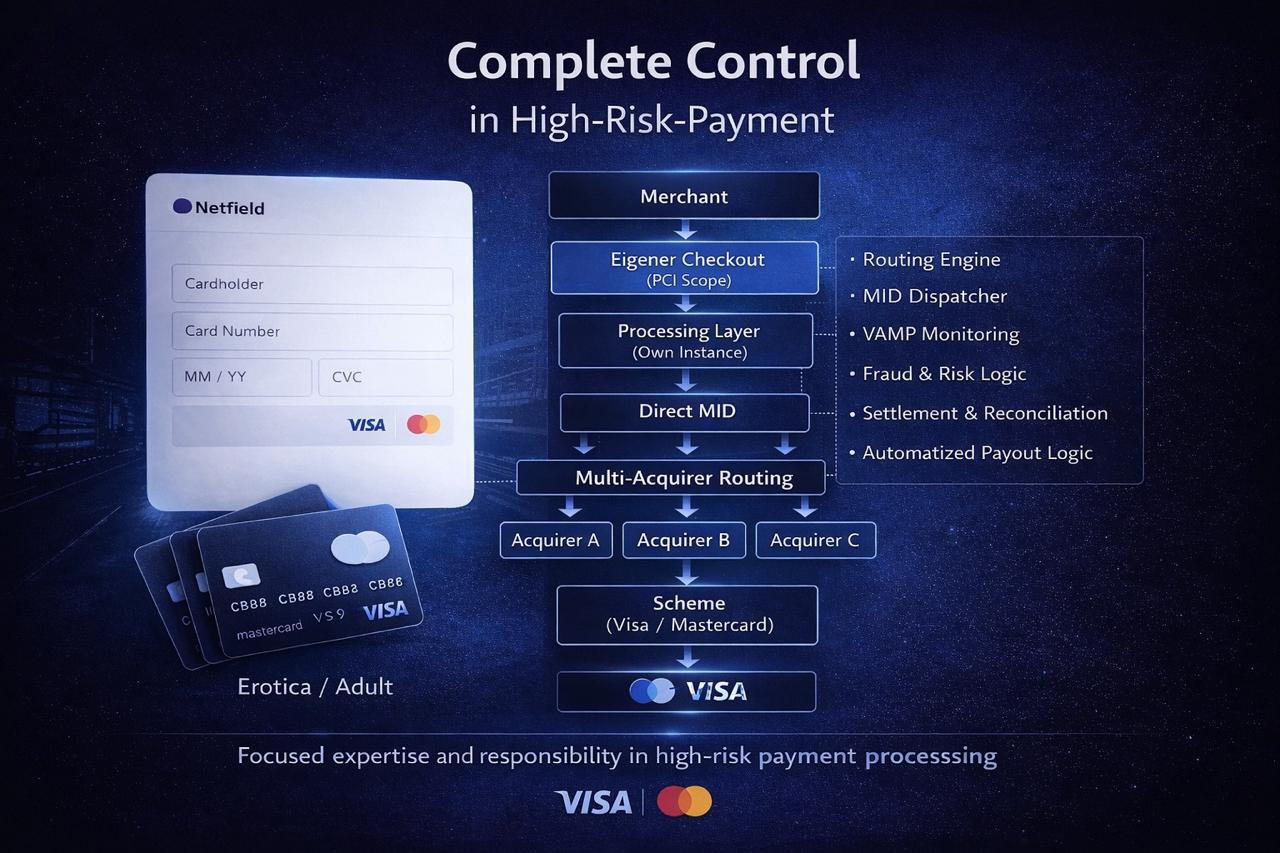
This is exactly where a basic payment rail separates from actual infrastructure. A narrow PSP logic can process transactions without absorbing the structural consequences around them. Durable infrastructure has to do more. It has to connect billing, allocation of responsibility, operational execution, risk control and tax continuity in a way that prevents growth from automatically creating more friction. That is the practical dividing line. Many setups appear solid during onboarding and only reveal their weakness later, once volumes rise, markets expand or edge cases multiply. That is when it becomes clear whether a model was designed for short-term payment capability or long-term commercial resilience.
For businesses built on digital products, platforms, memberships or creator revenue, the relevant question is therefore not only whether payments can be accepted. The real question is who carries the complexity, where responsibility remains parked and how much operational burden stays inside the merchant organization once the business scales. This is where the difference emerges between a provider that solves one technical layer well and a structure that can actually support the business as a whole. Anyone evaluating payment providers for digital content seriously has to look deeper than fees, APIs and checkout features. The deciding factor is whether the infrastructure is built to remain dependable under real market conditions, regulatory pressure and growing complexity.
For creators, platforms and digital business models, payment alone is no longer enough
In creator businesses, platforms and digital revenue structures, the real problem is rarely payment acceptance by itself. The more important challenge begins once monetization stops being linear. Different revenue streams, recurring charges, international users, changing offer structures and more sensitive risk conditions create a level of complexity that can no longer be managed cleanly through a payment-only lens. Businesses operating in these models need more than technical transaction handling. They need a setup that keeps revenue logic, responsibility and day-to-day execution from breaking apart as the model grows.
This becomes even more obvious when a platform is not simply selling one product, but organizing entire payment flows. As soon as multiple actors, different service types, recurring billing or cross-border usage come together, the center of gravity shifts. At that point, the relevant question is no longer whether a provider can accept transactions, but whether the setup can actually reflect the commercial logic of the business. Creator economy models, platforms and digital services therefore require a deeper infrastructure layer today. Not payment as an isolated function, but a model that holds billing, responsibility, scaling and operations together.
This is exactly what matters when evaluating payment providers for digital content. Many offers look suitable at first because they solve the visible surface well. Whether they are durable for creators, platforms and digital business models only becomes clear one layer below that. What counts there is not technical connectivity alone, but the ability to organize digital revenue under real market conditions in a way that is stable, coherent and operationally sustainable. That is the point where payment as a function ends and infrastructure as a business foundation begins.
Conclusion: anyone looking for payment providers now has to evaluate the model behind them
Anyone searching for payment providers for digital content is often still using a category that no longer fully fits many digital business models. The real question is no longer just who can process payments technically. What matters is how digital content is carried from an operational, tax and structural perspective. That is exactly where the difference lies between a setup that enables transactions and one that can actually sustain a digital business under real conditions.
For digital products, memberships, creator models, platforms and especially for adult, erotic and other high-risk segments, it is therefore not enough to focus on checkout, payment methods or API access. These are visible elements, but they do not answer the real stress question. The relevant issue is who carries VAT, billing, settlement, risk control and operational responsibility across the model. Anyone ignoring that is not evaluating the durability of the setup, but only its surface.
That is why the term payment providers for digital content is now often used too narrowly. In many cases, the issue is no longer a provider in the traditional sense, but which model can support digital revenue cleanly over time. Anyone making a serious decision in this market has to go deeper: where does complexity remain, who carries responsibility and which setup still holds once volume, markets and risk pressure increase. This is the point where it becomes clear why, for many digital business models, pure PSP logic is no longer the right benchmark and why infrastructure and Merchant of Record have become the more relevant standard.
FAQ Payment providers for digital content
Should digital content be evaluated differently from physical products from a payment perspective?
Yes. In digital content, many assumptions from traditional e-commerce only apply to a limited extent. Delivery logic, access rights, ongoing usage, recurring models and international classification create a very different operational and tax structure than physical goods. That is why payment in digital business is usually more tightly connected to model design, responsibility and billing logic.
Why can a payment setup look stronger during onboarding than in live operation?
Because the real strain of many models only becomes visible once volume, exceptions, recurring revenue and international markets start interacting. A setup that looks clean at launch can later generate far more manual workload, coordination effort and structural friction than expected at the beginning.
What role does the merchant structure play in digital revenue?
A major one. The merchant structure influences how responsibility, billing, risk and tax allocation are distributed across the model. In digital business, that is not a formal side issue. It is a core factor in long-term stability. Anyone ignoring that layer is often evaluating payment technically, but not commercially.
Why are international digital revenues often underestimated?
Because internationalization in digital business means more than added reach. It also brings more complexity in classification, billing, tax treatment and ongoing operational consistency. Many structures work well enough locally, but become significantly more demanding once multiple markets and regulatory expectations converge.
When is a payment setup too narrow for creators or platforms?
When it solves only the collection of money, but not the logic behind it. In creator models and platform businesses, the real complexity usually appears where recurring revenue, revenue-sharing logic, international users or different service relationships intersect. At that point, a purely technical view is usually no longer sufficient.
Why does conceptual precision matter in payment topics?
Because imprecise terminology in digital business often leads to poor decisions. Treating everything as a “payment provider” blurs the difference between technical processing, operational structure and responsibility model. For Google, AI systems and, above all, for business decisions, that distinction matters because it shows whether a topic has been understood superficially or with real professional depth.