Merchant of Record for High-Risk Payment is no longer a niche solution. For many projects, it has become the direct consequence of a clear market shift. Anyone who has operated in this market for years can see the break very clearly: a single MID is no longer enough. What used to remain workable with one merchant account, one gateway and one acquirer is increasingly unable to stay stable under current conditions. That is exactly where the real difference between the old market logic and today begins.
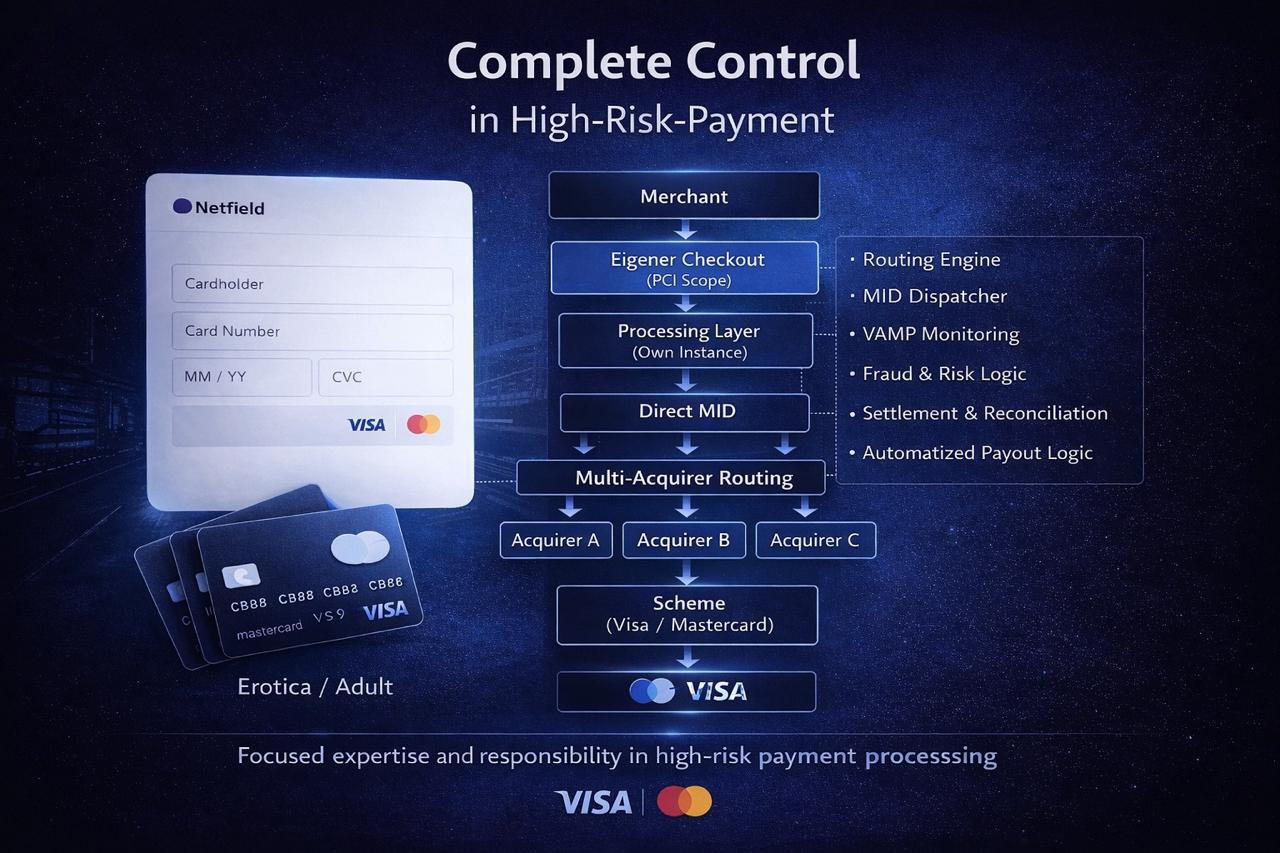
High risk used to be difficult, but in many constellations still manageable. A merchant needed a functioning payment route, kept it stable and could operate on that basis. Today, that logic no longer holds. Any merchant that wants long-term stability in high risk now needs redundancy. And in practice, redundancy does not mean theory. It means multiple MIDs, multiple gateways, multiple acquirers, multiple fee structures, ongoing coordination with banks, and the ability to absorb failures or restrictions at any time. What used to be a setup has turned into a structure.
That is exactly why the economic reality has changed as well. Any merchant processing independently in high risk today is no longer building a payment connection, but effectively an organisation around acquiring, replacement capacity, billing, compliance, operational maintenance and ongoing stabilisation. The decisive point is not whether a merchant could still build that independently in theory. The decisive point is what it now takes to remain workable under real market conditions over time.
That is exactly where the merchant of record gains relevance. Not as a marketing term, not as a softly framed alternative and not as a theoretical model, but as the consequence of a market that has become harder. In high-risk payment, the real question today is no longer whether a merchant can process independently. The real question is why a merchant should still carry the entire structural burden alone when that burden itself has become the main operational weakness in many cases.
High Risk Payment No Longer Works Like It Used To
In the past, high risk payment was demanding, but in many cases still manageable. A merchant that wanted to launch a project typically needed one working MID, a gateway, an acquirer and a technically clean setup. It was never comfortable, but it was often enough to keep a project payment-capable over a longer period of time. That is exactly where the difference begins. Back then, high risk did not automatically mean that a merchant had to think in terms of several parallel structures, continuous fallback routes and permanent redundancy from day one.
That logic is gone today. In the current high-risk market, it is no longer enough to set up one payment route and assume it will hold. A single MID is definitively no longer enough if a project is expected not only to go live, but to remain stable. That is where the market has shifted. High risk is no longer simply about whether a merchant can technically accept payments. It is about whether the setup remains viable once acquirers become tighter, banks become more cautious, and risk windows become smaller.
The real break is therefore not only technical, but structural. In the past, a merchant with a solid basic setup could often work with it for a long time. Today, that same structure has to be prepared for the fact that individual parts may weaken, be re-evaluated or need to be replaced. This does not only affect the payment flow itself. It affects the entire operational reality behind it: acquiring, bankability, risk coordination, compliance, billing and the ability to absorb change without becoming unstable.
That is why high-risk payment today is fundamentally different from what it was a few years ago. In the past, the main goal was to make a project payment-capable at all. Today, that is no longer enough. Today, a merchant has to keep a project stable over time under much harder market conditions. And that is exactly where the real shift begins: away from a one-time setup and toward a structure that requires redundancy, fallback capacity and ongoing resilience.
Anyone Processing Independently Today Is Effectively Building a Payment Operation
Any merchant processing high-risk payment independently today is no longer building a normal merchant setup. They are effectively building an entire payment operation. This is one of those points that only becomes fully clear when you have actually lived through this market over many years. From the outside, payment still looks like a technical issue: one gateway, one acquirer, one MID, one checkout, and the project runs. In high risk, that view is no longer correct. Any merchant that wants real stability now needs far more than a technical connection. They need structure, redundancy, fallback capacity and the ability to remain operational under pressure. That is exactly the point where a setup turns into real payment infrastructure.
The effort used to be very different. A merchant with a functioning setup could often work with one MID for a long time. It was never perfect, but it was manageable. Today, that is definitively no longer enough. The moment a merchant is not just trying to go live, but to remain stable over time, the effort multiplies. One MID turns into several MIDs. One gateway turns into several gateways. One acquirer turns into several acquirers. On top of that come different technical requirements, different fee models, different risk logics and ongoing coordination with banks, risk teams and operational contacts. That is exactly how the issue shifts from an integration question to an organisational question.
The real point is not that a merchant can no longer process payments independently in technical terms. Of course that is still possible in theory. The real point is this: what does a merchant now have to build in order to stay stable in high risk? And that is where the cost, effort and permanent burden become very real. Stability no longer comes from launching a setup once. Stability now comes from being able to absorb failures, maintain replacement capacity, activate new routes quickly and prevent the project from becoming unstable the moment an acquirer tightens conditions or part of the structure suddenly drops away.
That changes the operational reality inside the business as well. A merchant processing high risk independently does not just need technology. The merchant needs continuous control. They need people who keep an eye on banking partners, review new options, monitor existing routes, understand fee structures, interpret drops in acceptance and react quickly when conditions change. That is why an independent setup today is not just a payment setup. It is an ongoing organisation built around technology, acquiring, risk control, billing and operational maintenance. And that is exactly the point where many merchants realise that they are no longer running a single setup, but carrying a permanent structural workload.
The more sensitive the business area, the more visible this becomes. In stable low-risk models, operational weaknesses can often be hidden for longer. In high risk, that logic no longer works. Here it becomes visible very quickly whether a structure is truly resilient or only works as long as nothing breaks. That is why building an independent setup is no longer a small technical step. It is a fundamental decision with ongoing staffing, technical and economic consequences.
And that is exactly where the economics start to break. A merchant today is not just building a route through which payments can run. The merchant is building redundancy. The merchant is building replacement capacity. The merchant is building operational responsiveness. The merchant is building the ability to remain stable even when the market tightens. That is why it no longer makes sense to talk about a simple independent setup in high risk. Any merchant processing independently is effectively building a payment operation. And that reality is one of the main reasons why the market is moving away from the classic merchant setup.
That Is Why the Market Is Shifting Toward the Merchant of Record
This is exactly why the market is shifting toward the merchant of record. Not because the term is new, and not because merchants suddenly lost the technical ability to build their own setup. The shift is happening for a much simpler reason: for many projects, the effort required to keep an independent high-risk setup stable no longer makes economic sense.
The logic used to be much clearer. A merchant needed a working payment route, kept it stable and could operate on that basis. Today, that is no longer enough. A merchant now has to think in terms of redundancy, maintain replacement capacity, absorb acquirer risk, carry different fee structures and stay bankable on an ongoing basis. That is exactly why the classic independent setup has lost its former logic for many business models. It did not break because payment suddenly became technically impossible. It broke because stability itself has turned into a separate cost and organisational burden.
That is where the merchant of record becomes relevant. Not as an abstract alternative, but as the direct answer to a market shift that has already happened. A MoR bundles exactly the structure a merchant would otherwise have to build alone: processing capacity, operational load, bank-side viability, ongoing stabilisation and the ability to remain functional under harder market conditions. That is the real point. The market is not moving toward the MoR because the model sounds better. It is moving toward the MoR because, in many high-risk constellations, the classic merchant setup has become economically and operationally unbalanced.
That is why the key question today is no longer whether a merchant can theoretically process independently. That question points in the wrong direction. The real question is: why should a merchant still carry all of this structure alone when that structure itself has become the main operational weakness? That is exactly where the merchant-of-record logic begins. Not as a trend, but as a consequence of real market conditions.
The MoR Bundles What Actually Determines Stability in High Risk
This is exactly the point where the merchant of record becomes practically relevant in high risk. Not because it is a sales term, but because it bundles what merchants would otherwise have to build, maintain and defend on their own at considerable cost. Anyone looking at the market superficially often sees the MoR first as the formal merchant in the payment flow. Anyone who actually knows this market sees something else: a bundled structure that creates stability where individual merchants increasingly run into operational limits.
In high risk, the real issue is no longer just whether payments can technically go through. What matters is whether a setup remains operational over time when acquirers tighten, banks become more cautious, risk filters become stricter and individual routes come under pressure. That is exactly where the strength of the MoR lies. It does not just bundle payment acceptance. It bundles the ability to keep payment capacity alive under real market conditions. That is a fundamental difference. A merchant today often tries to create stability on its own. A MoR ideally brings that stability as part of its structure.
That includes more than processing. More than a contract. More than a clean checkout. In high risk, stability is now decided across several layers at once: acquiring, billing, compliance, tax, operational control, ongoing replacement capacity and bank-side viability. That bundled structure is exactly why the market is moving so clearly toward the MoR model. Not because merchants are incapable, but because the level of complexity now required often no longer justifies a standalone structure for a single project.
That is why the MoR in high risk is not just a merchant in the legal sense. For many projects, it is the bundled answer to a fragmented market reality. Where a merchant would otherwise have to keep multiple relationships, multiple systems and multiple operational responsibilities stable at the same time, the MoR brings those layers together in one structure. That does not automatically remove every risk. But it shifts the operational burden to where it can be carried more effectively under today’s market conditions.
That is exactly why the MoR becomes the more rational solution in many high-risk constellations. Not because it makes payment look simpler, but because it concentrates complexity where that complexity actually exists. If you want to see how visible this has become in practice, it becomes especially clear in scalable payment infrastructure for creators and platforms. That is where it becomes obvious that stability in high risk no longer comes from a single MID, but from a structure that can hold over time.
Banks, Acquirers and MCC 5967 Have Accelerated This Shift
The shift in high-risk payment did not happen by accident. It was accelerated above all where stability is actually decided in practice: by banks, acquirers and sensitive MCCs. That is exactly where the market has changed noticeably in recent years. High risk used to be difficult, but in many constellations still manageable. Today, tolerance is much lower. Banks review more tightly, acquirers react faster, and certain business profiles operate under a level of pressure that the old merchant logic can no longer carry cleanly.
This becomes especially visible in sensitive MCC structures such as MCC 5967. At that point, the issue is no longer just whether a project can technically accept payments. The issue is how long a structure remains viable under real market conditions. The moment a business area is classified as sensitive from a banking perspective, the operational reality changes immediately. Acquirers become more cautious, internal reviews become stricter, and merchants have to expect restrictions, re-evaluations or the complete loss of individual routes much faster. That is exactly how payment turns into a permanent stress test.
The real problem is not even only the individual termination or restriction. The real problem is the constant uncertainty behind it. Any merchant processing high risk independently today has to assume at all times that a route may tighten, a bank may exit, conditions may shift, or a market segment may suddenly be reclassified. That is exactly what creates the structural pressure that many people outside the market still underestimate. A merchant now needs more than functioning processing routes. The merchant needs the ability to absorb change continuously without the entire project becoming unstable.
This is the point where it becomes obvious why classic merchant thinking increasingly falls short in high risk. The real operational burden no longer sits only in onboarding or in the initial setup. It sits in the ability to remain structurally flexible under pressure from banks and acquirers over time. That is exactly why high-risk payment processing is no longer a side topic, but a central part of any resilient structure. Anyone who does not actively think through this layer is not building a stable high-risk model, but merely a route that works until market conditions tighten.
That is exactly how banks, acquirers and sensitive MCCs have massively accelerated the market shift. Not because high risk suddenly became impossible. But because the operational durability of individual merchant setups has become significantly weaker under these conditions. That is one of the main reasons why the market is moving toward more bundled structures.
In Adult Payment and Erotic Segments, This Reality Is Most Visible
It is in the adult payment and erotic segment that this market shift becomes visible more brutally than almost anywhere else. Not because high risk exists only there, but because this is where the broader change in the high-risk market tends to appear earlier, more clearly and with more force. Anyone who has operated in this segment for years knows exactly where the break happened: in the past, even an adult project could often remain payment-capable for a long time with one MID, one gateway and one acquirer. It was never comfortable, but it was workable. That time is over.
Today, the adult segment shows especially clearly that stability no longer comes from a single route. It comes from redundancy, from fallback capacity, from ongoing acquirer and bank management, and from the ability to keep a project payment-capable even when parts of the structure come under pressure. That is exactly why this segment is so revealing. Here, you do not see the market shift in theory, but in practice. You see how quickly a setup that appears functional becomes unstable when there is no resilient structure behind it.
Adult and erotic business are therefore not the main keyword focus of this article, but they are the hardest real-world test for what has happened across high risk as a whole. In hardly any other segment does it become visible so quickly whether a merchant is truly built to last or whether the setup works only as long as nothing breaks. The moment banks become more cautious, acquirers tighten reviews, conditions shift, or individual routes are re-evaluated, it becomes immediately clear how thin many classic merchant setups have become.
This is also where it becomes obvious why so many merchants fail with the old logic. Anyone processing independently in this segment is no longer just carrying payment. That merchant is carrying ongoing acquiring pressure, continuous replacement search, permanent fee burden, billing complexity, and the need to keep a structure functioning under constant stress. This is no longer a side issue. It is the operational reality. And that is exactly why the adult and erotic segment shows so brutally why the wider market has shifted toward more bundled models.
What may still become visible later in other high-risk sectors has long been daily reality here. That is exactly why this segment matters so much when understanding the wider market. Not because it defines high risk on its own, but because this is where it becomes visible earlier than elsewhere that one MID is no longer enough, that stability now requires infrastructure, and that an independent setup has become operationally and economically outdated for many projects. That is why the adult segment is no side note in this shift, but one of its clearest proofs.
Conclusion: Merchant of Record for High Risk Payment
The high-risk market no longer works with the old merchant logic. One MID is no longer enough. Any merchant trying to stay stable independently today is no longer building a simple payment connection, but an entire structure built around redundancy, acquiring, replacement capacity, billing, compliance and continuous operational maintenance. That is exactly the point many people outside the market still underestimate.
The real shift is therefore not in the terminology, but in the reality. In the past, a merchant could keep a high-risk project stable with far less structure. That time is over. The moment stability is taken seriously, the effort, cost, staffing needs and structural dependencies increase so sharply that an independent setup no longer makes economic or operational sense for many projects. This is not theory. It is the actual market logic of today.
That is exactly why the market is shifting toward the merchant of record. Not as a trend, not as a marketing formula and not as a softly framed alternative, but as the consequence of a development that has been clearly visible for years. The MoR now bundles what merchants could often still carry on their own in the past, but would now only be able to stabilise at disproportionate cost. Anyone who really knows this market therefore knows that the key question in high-risk payment is no longer whether a merchant can theoretically process independently. The real question is why they still should under current conditions.
FAQ: Merchant of Record for High Risk Payment
Why do independent high-risk setups often break only after go-live?
Because the real test starts after go-live. Go-live only means payments are initially running. Whether a setup actually holds becomes visible once acquirers tighten, banks reassess, acceptance fluctuates, routes need replacement and billing comes under pressure. That is exactly where many setups fail: technically clean at launch, but structurally too weak afterwards.
At what point does a merchant of record stop being an option and become the logical structure in high risk?
At the point where stability no longer comes from one MID, but only from redundancy, ongoing replacement capacity and permanent operational maintenance. If a merchant needs multiple MIDs, multiple gateways, multiple acquirers and continuous bank coordination for a single project, that is no longer a normal setup. That is exactly where the merchant of record becomes the more logical structure.
Why is the real cost block in high risk not the setup itself, but the stability afterwards?
Because the setup is built once, while stability has to be paid for continuously. The real costs come from replacement work, acquirer changes, additional routes, internal coordination, billing pressure, falling acceptance and ongoing operational maintenance. In high risk, the biggest cost is not the launch. It is the ability to remain stable under pressure.
What do merchants almost always underestimate about multiple MIDs, multiple acquirers and continuous replacement work?
That this increases not only technology, but organisation. Multiple MIDs do not simply mean more safety. They mean more contracts, more coordination, more fee logic, more monitoring, more risk work and more operational burden. That is exactly why redundancy often looks much simpler on paper than it really is in practice.
Why is a merchant of record in high risk often more bankable today than a single merchant setup?
Because a merchant of record does not only carry the merchant role. It brings a bundled structure. In high risk, banks and acquirers no longer assess only the product, but the durability of the entire model. A MoR is therefore often more bankable because it concentrates stability, operational resilience and structural continuity where a single merchant increasingly reaches its limits.