
High risk payment processing is not simply about handling payments, but about the technical and operational control of complex payment flows within demanding business models.
While standard payment solutions focus on forwarding transactions, high-risk environments require much more: control over payment flows, risk management, and the ability to process international transactions reliably.
In platform-based models, digital services, or subscription businesses, payment processes are not linear. They consist of multiple layers that must be actively managed and coordinated.
The real difference therefore lies not in the transaction itself, but in the infrastructure behind it. High risk payment processing means that transactions are not just processed, but analyzed, routed, and controlled within a structured system.
A broader overview of high-risk business models can be found in High Risk Payment.
This article focuses on the technical layer: how payment systems are structured, which components are involved, and how control over transactions is achieved.
What high risk payment processing really means
In a technical context, high risk payment processing is not just about executing transactions, but about the active control of the entire payment flow.
In simple payment setups, a transaction is initiated, forwarded, and processed. In high-risk environments, this model is insufficient. Transactions must be evaluated in real time, distributed across different systems, and managed based on risk, origin, and payment type.
Processing in this context means that each transaction is part of a broader system. It is not treated in isolation, but within the context of risk profiles, payment flows, and banking requirements.
A key element is the ability to make decisions within the payment flow. This includes determining which acquiring bank processes a transaction, how certain payment types are prioritized, and how the system reacts to changing risk conditions.
This control is not manual, but embedded within a structured infrastructure that analyzes and responds to payment flows in real time. This is where the difference between simple payment handling and true processing becomes clear.
The foundation for this is a robust payment infrastructure, where all relevant components are integrated.
High risk payment processing is therefore not about accepting payments—it is about controlling, optimizing, and sustaining them over time.
Aggregator models vs real processing structures
In high risk payment processing, it quickly becomes clear that not all integrations are equal. Many solutions rely on aggregator models, where transactions are processed through the infrastructure of a third party.
While these models allow for fast onboarding, they offer limited control over the actual payment flow. Merchant accounts, routing decisions, and parts of the risk management are typically outside direct control.
In contrast, a dedicated processing structure allows payment flows to be managed within a controlled system environment. Transactions are not just forwarded, but actively processed according to defined logic.
The difference is therefore not functionality, but control over the payment architecture.
Aggregator models standardize processes, while an independent infrastructure enables flexible routing, risk-based decision making, and the use of multiple acquiring relationships.
In high-risk environments, this distinction becomes critical. Payment systems must not only function, but remain stable and adaptable under changing conditions. These differences become especially visible in sensitive high-risk environments, such as digital content platforms or in the field of adult payment.
A detailed comparison of both approaches can be found here: aggregator vs payment infrastructure
In this context, high risk payment processing is not about connecting to a system, but about operating and controlling one.
Direct MIDs and control over the payment flow
A key difference in high risk payment processing lies in the structure of merchant accounts. While aggregator models rely on third-party merchant IDs, a dedicated processing setup is built on direct MIDs (merchant IDs).
These direct MIDs are connected directly to acquiring banks and form the foundation of a controllable payment architecture. Transactions are not routed through external systems but processed within an internal structure.
The main advantage is full control over the payment flow. Businesses can determine how transactions are routed, which banking connections are used, and how different payment types or risk profiles are handled.
This creates an environment where payment processes are not static, but actively managed. Decisions are not outsourced, but remain part of the internal system logic.
Such control is only possible within a structured payment infrastructure, where merchant accounts, acquirers, and processing logic are fully integrated.
In high-risk environments, this distinction is critical. Direct MIDs enable stability, flexibility, and independence from external aggregator structures.
High risk payment processing is therefore not just about integration—it is about building a system where transactions are actively controlled and managed over time.
Routing, acquirer logic and intelligent transaction control
In high risk payment processing, it is not only about whether a transaction is processed, but how and through which structure it is processed.
A key component is intelligent transaction routing. Instead of sending payments through a single acquiring bank, transactions are dynamically distributed across a structured system. This is based on parameters such as transaction origin, card type, risk profile, and bank-specific requirements.
This routing is not random, but governed by defined logic. Transactions are analyzed and directed to the most suitable acquiring partner, allowing for optimized approval rates while maintaining risk control.
Another critical element is the use of multi-acquirer setups. By connecting multiple banking partners, the payment architecture becomes more flexible and less dependent on a single provider. Changes in risk evaluation or restrictions can be managed proactively.
In advanced processing environments, these decisions are executed in real time. Routing logic operates automatically, based on structured data and system-defined rules.
This is where the difference between simple payment handling and real processing becomes clear. Transactions are not just executed—they are managed within a system designed for performance, stability, and adaptability.
Within a properly designed infrastructure—such as a dedicated high-end processing layer—this results in a system that does not just handle payments, but actively optimizes and controls them.
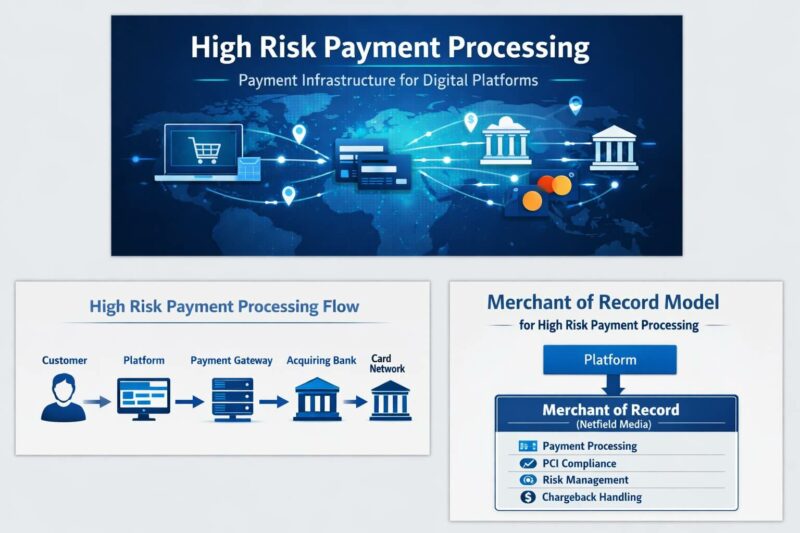
Platform → Merchant of Record (e.g. Netfield Media) → Payment processing, PCI compliance, risk management
Control over transactions, data, and risk structures
In high risk payment processing, technical complexity does not end with routing or acquiring connections. The defining factor is control over transactions and the underlying data structures.
Every transaction generates a wide range of data: origin, payment type, risk profile, processing path, and outcome. In simple systems, this data is merely logged. In a real processing environment, it is actively used.
These data points form the foundation for decision-making within the payment flow. They allow transactions to be evaluated in real time, patterns to be identified, and processes to be continuously optimized. This creates a system that evolves dynamically rather than reacting statically.
Another key component is continuous monitoring. Payment flows are not just processed—they are constantly analyzed. Anomalies, changes in approval rates, or shifts in risk profiles can be detected early and incorporated into system logic.
With this level of control, payment processing becomes an active control system rather than a passive function. Decisions are no longer external—they are embedded within the infrastructure.
At the same time, compliance with security standards is critical. Requirements such as PCI DSS compliance define how data is handled, stored, and protected.
Further details can be found in the dedicated article on PCI DSS compliance, as well as from the official PCI Security Standards Council (PCI DSS).
In advanced processing environments, this results in a system where data, transactions, and risk structures are interconnected. Payment is no longer just executed—it is understood, controlled, and actively managed.
Settlement, banking integration and control over fund flows
In high risk payment processing, the process does not end with transaction authorization. The real stability and control of a system become visible in the next step: settlement and the management of fund flows.
While basic payment setups treat payouts as a downstream function, in a true processing environment settlement is an integral part of the overall architecture. Payment flows are not simply completed—they are structured, allocated, and managed within the system.
A key element is direct integration with banking systems. Through interfaces such as EBICS (Electronic Banking Internet Communication Standard), payment processes can be fully embedded into the infrastructure. This allows payouts to be system-driven rather than manually executed.
This level of integration enables precise control over fund flows. Transactions can be processed according to defined logic, distributed across multiple accounts, and executed in structured cycles. Settlement is no longer a separate step, but part of the overall processing chain.
In high-risk environments, this control is essential. Different markets, currencies, and regulatory requirements demand systems that are both flexible and stable. Payment flows must continue to operate reliably even under changing conditions.
In advanced processing environments, this creates a continuous cycle—from transaction processing and routing to controlled settlement. This is what defines a fully integrated payment architecture.
Conclusion: processing is control – or it isn’t
High risk payment processing is not an extension of existing systems. It is the question of whether payment flows are actively controlled or passively executed.
Once transactions become non-linear, simply forwarding payments is no longer sufficient. Without control over routing, data, banking connections, and settlement, systems remain dependent on external decisions.
True processing structures shift this dynamic. Transactions are not just handled—they are governed within an internal logic. Decisions are made inside the system, not outside of it.
In such architectures, merchant accounts, acquirers, routing, monitoring, and settlement form a unified system. This creates an environment where payment processes are not just functional, but predictable, controllable, and resilient.
This is the real dividing line in the market.
Between systems that enable payments—
and systems that control them.
Processing is not an interface.
It is infrastructure.
FAQ
How many acquirers should a high-risk setup have?
There is no fixed number, but relying on a single acquirer is considered a structural risk. Multiple acquirers allow transactions to be distributed flexibly and help maintain stability under changing conditions.
What role do BIN data play in payment routing?
BIN data (Bank Identification Number) provide insights into the issuing bank, country, and card type. This information can be used to route transactions more effectively and improve authorization rates.
Why is real-time decision logic critical in processing?
Risk profiles and banking requirements change constantly. Systems must be able to evaluate transactions in real time and adjust routing or processing logic immediately.
How is payment system stability ensured technically?
Stability is achieved through redundancy. This includes multiple acquirers, flexible routing, and systems that can compensate for failures or restrictions automatically.
Which data are most important for optimizing payment processes?
Beyond transaction data, pattern recognition, risk classification, and approval rates are key. These insights enable continuous optimization of payment performance.
What differentiates scalable processing systems from static setups?
Scalable systems adapt dynamically to increasing volumes and changing conditions, while static setups rely on fixed structures and quickly reach their limits.