
High Risk Payment
High risk payment refers to payment processing for businesses whose operating models are considered more complex by banks or payment providers than traditional online retail. This often includes digital platforms, internationally operating services, or subscription-based business models with recurring transactions.
Many conventional payment providers are primarily designed for standard e-commerce structures. As a result, businesses with more complex payment flows or international transaction patterns may encounter limitations when using typical payment solutions.
Netfield Media provides payment infrastructure designed for digital platforms and content providers that operate internationally and require flexible solutions for managing their payment processes.
What does High Risk Payment mean?
The term high risk payment refers to payment processing for business models that are assessed by banks or acquiring institutions as carrying a higher operational or financial risk profile. This classification does not necessarily indicate problematic activity but often reflects more complex transaction structures.
Several factors can contribute to a high-risk classification, including:
-
international payment flows across multiple markets
-
higher potential chargeback rates
-
digital platform or content-based business models
-
subscription services with recurring billing
-
additional regulatory or compliance requirements
Businesses operating under these conditions typically rely on specialized payment solutions designed to manage these technical and regulatory challenges.
A more detailed technical explanation of the payment flow can be found in the article High Risk Payment Processing.
Typical industries in High Risk Payment
Many digital business models require specialized payment solutions. Platforms with international users or digital content are particularly often classified in this category.
Typical industries include:
-
adult and erotic platforms
-
dating platforms
-
creator and content platforms, for example a dedicated creator content platform
-
video or streaming services
-
platforms using credits or virtual goods
Platforms operating in the adult content sector often face additional requirements in payment processing.
More information can also be found on our pages about Adult Payment.
These industries often require payment providers with experience in international platform structures.
Digital platforms frequently operate with international users and different payment models. As a result, additional requirements arise for payment processing that go beyond traditional online shop structures.
Platforms offering memberships, credits, or recurring payments particularly depend on stable payment processes. A specialized infrastructure helps process transactions reliably while meeting regulatory requirements.
For platforms with a rapidly growing user base, a scalable payment structure is essential.
How high risk payment works technically
The basic structure of an online payment in the high risk sector does not differ significantly from a standard credit card transaction. Payments are processed through a sequence of technical systems connecting the merchant, payment provider, and banking networks.
A typical transaction usually follows several steps:
-
A customer enters payment details on a website or digital platform
-
A payment gateway securely transmits the payment request
-
The request is forwarded to an acquiring bank
-
Through card networks, the transaction is routed to the customer’s issuing bank
-
The issuing bank authorizes or declines the payment
In high-risk payment environments, the main differences are not in the transaction flow itself but in the supporting payment infrastructure.
This infrastructure often includes:
-
risk assessment and transaction monitoring systems
-
fraud detection and monitoring tools
-
chargeback management processes
-
international payment routing for global transactions
These components help ensure reliable payment processing while managing regulatory requirements and operational risks.
Merchant of Record in high risk payment
Many platform operators in the high-risk payment sector use a merchant of record (MoR) model. In this setup, a specialized provider acts as the legal merchant of record toward payment networks, banks, and in some cases toward the end customer.
The merchant of record is therefore officially recognized as the merchant within the payment ecosystem and assumes responsibility for various operational and regulatory functions.
Typical responsibilities of a merchant of record include:
-
processing payments through different payment networks
-
managing tax obligations across multiple jurisdictions
-
generating invoices and transaction documentation
-
handling chargebacks and dispute management
-
ensuring compliance with security standards such as PCI-DSS
For digital platforms with international users, this model can simplify operational processes by centralizing certain payment and compliance responsibilities.
Platforms serving global audiences, multiple currencies, or subscription-based services often benefit from the structured and scalable payment processes enabled by a merchant-of-record setup.
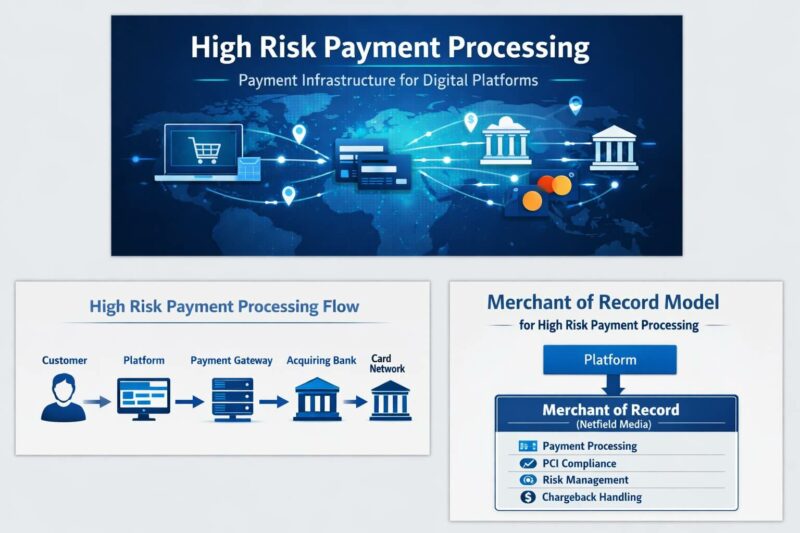
Platform → Merchant of Record (e.g. Netfield Media) → Payment processing, PCI compliance, risk management
Infrastructure and security in high risk payment
In the high-risk payment sector, technical infrastructure plays a critical role. Digital platforms often need to process large volumes of international transactions while maintaining strict security requirements.
Beyond basic payment processing, systems must remain stable, scalable, and reliable, particularly for platforms with growing user bases or increasing transaction volumes.
One of the most important global security standards in this area is PCI DSS Compliance (Payment Card Industry Data Security Standard). This framework defines requirements for the secure handling of credit card data and is widely required by payment networks and financial institutions.
Key requirements include:
-
encrypted transmission of sensitive payment data
-
secure storage and processing of payment information
-
clearly defined access controls within technical systems
-
continuous monitoring of transactions and system access
In addition to data security, payment infrastructure stability is essential. Platforms must ensure that payment processes remain reliable even as transaction volumes increase.
Modern payment solutions therefore rely on technologies such as:
-
automated monitoring systems
-
real-time fraud and risk detection
-
scalable payment architectures for international transactions
These systems help detect unusual transactions early and reduce operational risks while ensuring long-term stability in payment processing.
For platform operators, this results in more predictable and reliable payment operations as their business grows.
High risk payment for platforms
Digital platforms often use payment models that differ significantly from traditional online stores. While standard e-commerce typically focuses on single product purchases, platform-based businesses frequently rely on more complex payment structures and multiple transaction types.
Common examples include:
-
subscription-based memberships
-
credit or token systems within a platform
-
digital or virtual goods
-
revenue-sharing or compensation systems for creators
These models often involve multi-layer payment flows, where transactions occur between users, platform operators, and sometimes third-party content providers. This creates additional requirements for payment infrastructure.
Beyond basic payment processing, platforms must also handle international users, multiple currencies, and recurring billing structures. As user bases grow, transaction volumes and operational complexity typically increase as well.
Specialized high-risk payment infrastructure helps platforms manage these challenges by providing flexible payment architectures, international acquiring connections, and systems for monitoring and risk management.
Netfield Media supports in merchant of record modell platform operators with payment solutions designed for digital business models and international payment environments.
Chargebacks and risk management in high risk payment
An important aspect of payment processing in high-risk industries is chargeback management. A chargeback refers to the reversal of a credit card transaction initiated by the cardholder through their issuing bank.
Chargebacks may occur for several reasons, including:
-
transactions that appear unclear or unfamiliar on a customer’s credit card statement
-
disputes between customers and service providers
-
suspected fraud or unauthorized transactions
-
insufficient communication regarding subscriptions, trial periods, or automatic renewals
For platform operators, elevated chargeback rates can create significant operational challenges. Banks, acquiring institutions, and card networks closely monitor these metrics. If certain thresholds are exceeded, this can lead to stricter risk assessments or limitations in payment acceptance.
For this reason, risk management is a key component of payment infrastructure, particularly for digital platforms serving international audiences.
Modern payment systems therefore include a range of monitoring and risk management tools, such as:
-
chargeback monitoring and analytics
-
fraud detection systems for suspicious transactions
-
transaction analysis tools
-
automated risk evaluation of individual payments
These technologies help identify potentially problematic transactions at an early stage and reduce the likelihood of chargebacks.
For platforms with international users and complex payment models, structured chargeback management is an essential element of stable payment operations.
Conclusion
High risk payment refers to payment processing for business models with requirements that extend beyond traditional online commerce. Digital platforms, international services, and subscription-based businesses often operate with more complex payment structures, multiple transaction types, or global user bases.
These characteristics mean that many traditional payment providers are not always optimized to support such business models. Banks and payment networks typically evaluate platform-based businesses based on additional factors such as international payment flows, chargeback ratios, and regulatory considerations.
As a result, many digital platforms rely on specialized payment solutions designed to handle these requirements. This often includes robust technical infrastructure, international payment connectivity, and systems for risk management, fraud detection, and chargeback monitoring.
Models such as merchant of record can help structure payment processes while also addressing tax and regulatory responsibilities. For platform operators with international users or complex payment models, this approach can simplify the operational aspects of payment management.
With the right payment infrastructure in place, even complex platform ecosystems can operate reliably while supporting growing transaction volumes, international payments, and diverse billing models.
Netfield Media supports platform operators and digital businesses with payment solutions designed for international platforms and complex payment environments.
FAQ
What is high risk payment?
High risk payment refers to payment processing for business models that banks or payment providers classify as having a higher operational or financial risk profile. This classification is usually related to the structure of the business model rather than illegal activity. Businesses with international customers, subscription services, digital content platforms, or complex payment flows are often placed in this category.
Which industries are commonly considered high risk?
Several digital industries are frequently classified as high risk by payment providers and banks. Examples include adult platforms, dating websites, creator or content platforms, streaming services, and platforms offering credits or virtual goods. These models often involve international users, recurring payments, or multi-party payment flows.
Why do platforms need specialized payment providers?
Traditional payment providers are often designed for standard e-commerce transactions. Digital platforms, however, frequently operate with subscription billing, international transactions, creator payouts, or credit systems. These structures require more flexible payment infrastructure and risk management systems.
What is a merchant of record?
A merchant of record (MoR) is the legal entity that acts as the official merchant in a payment transaction. The MoR manages responsibilities such as payment processing, tax handling, invoicing, and chargeback management. This model is commonly used by digital platforms that operate internationally or require centralized payment compliance.
What is PCI DSS and why is it important?
PCI DSS (Payment Card Industry Data Security Standard) is a global security framework designed to protect credit card information during payment processing. Companies that handle credit card transactions must comply with these requirements, which include data encryption, access controls, and security monitoring.
Why are chargebacks important in high risk payment?
Chargebacks occur when a customer disputes a transaction through their bank and requests a reversal of the payment. In industries classified as high risk, payment networks closely monitor chargeback ratios. If these ratios exceed certain thresholds, it can affect payment acceptance or relationships with acquiring banks.