Merchant of Record as a start in adult payment is now, for many business models, not just a pragmatic option but the cleaner order of entry. Anyone entering adult payment or, more broadly, high-risk payment is no longer operating under conditions where building the most direct own setup automatically counts as the more professional path. This is still widely misunderstood in the market. Many businesses continue to begin with the question of how quickly they can establish their own payment structure. The more important question today is whether the business can carry its first real market phase cleanly from an operational, structural, and organisational point of view.
This is exactly where Merchant of Record becomes the more sensible entry model for many projects. Not because every direct structure is wrong, and not because MOR is simply a convenient fallback for difficult cases. The difference runs deeper. A new adult business does not primarily need maximum direct control on paper in its first phase. It needs a workable first layer in which the offer, market presence, operating processes, and payment infrastructure can actually come together in a stable way. Businesses that skip that order often build friction into the launch phase and later misread it as a payment problem, even though it really came from trying to force direct depth too early.
That is why this article is not meant to be a generic explanation of MOR, and not a full economic debate about direct setups either. Its point is narrower and, under current market conditions, more useful: anyone entering adult payment today should no longer think first in PSP logic or own-setup logic, but in viable entry models. That is exactly why Merchant of Record has become the more rational first step for so many projects in today’s adult payment market.
Why the classic entry via a PSP or direct setup often falls short today
Anyone entering adult payment, erotic payment, or high-risk payment today often still thinks in a pattern that comes from a very different market environment. The first reflex is still to look for a PSP, build a direct setup, and sort out the remaining issues later. At first glance, that sequence feels logical because it is familiar. In today’s market, however, it often falls short because it still treats payment as an isolated function, even though it has long become part of the broader payment infrastructure.
The problem does not begin only when an application is rejected or when a provider later asks for more documentation. It starts much earlier, with the assumption that entering an adult or erotic business model still works roughly the same way it does in less sensitive sectors. In many cases, that is no longer true. Anyone entering this space is not just operating in a higher-risk segment. They are entering a market in which review, traceability, structure, responsibility, and ongoing operational resilience are tied together much more tightly than they used to be.
That is why the old idea of “secure payment first, solve the rest later” has become too simplistic. In practice, a workable market entry no longer depends only on whether payments can technically be processed. What matters is whether the model as a whole is structured early enough so that risk, responsibilities, compliance requirements, and operations actually fit together. This is exactly where traditional entry paths through a PSP or a direct setup increasingly come under pressure. Not because they are impossible in principle, but because they often respond too late to the structural questions that now define viability.
That is also where many new or growing businesses make the wrong first move. They search for a payment route first, when what they really need is the right sequence. Anyone who still treats market entry as a standard provider question underestimates how closely high-risk payment is now linked to responsibility, documentation, internal structure, and operational discipline. That is why the traditional entry path is no longer the obvious default in many cases. It has increasingly become the first strategic mistake.
Why Merchant of Record is often the smarter starting point today
This is exactly where Merchant of Record has become the smarter starting point for many business models in adult payment, erotic payment, and high-risk payment. Not because MOR removes every challenge, and not because it is a universal end model for every case. The real point is different: MOR addresses the part of the market that now makes entry genuinely difficult. And that is no longer just technical payment acceptance. It is the question of how responsibility, risk, compliance, and operational resilience are structured from the beginning.
Many people still talk about MOR as if it were mainly a convenient fallback option for difficult cases. From today’s market perspective, that view is too narrow. For many new or growing businesses, Merchant of Record is strong precisely because it creates a cleaner structure at the entry stage. A business that does not have to build its own direct construct of contracts, review logic, operational ownership, and ongoing payment maintenance from day one does not just save time. It also reduces the number of points at which the model can become unstable early on. In today’s market, that is often the real difference.
This matters especially where a business is already developing a clearer product, positioning, offer structure, platform logic, or go-to-market approach, but still does not yet have payment infrastructure strong enough to carry a direct setup in a stable way. In that kind of situation, MOR is not just a technical detour. It is often the more sensible sequence. First build a stable market foundation, then, if it makes strategic and economic sense, build more direct depth later. Many mistakes in today’s adult market do not happen because the business model itself is weak. They happen because the order of decisions is wrong.
That is why Merchant of Record is often stronger as an entry model than the traditional direct route. Not because control does not matter, but because control is often overvalued in early phases while structural stability is undervalued. Businesses that try to carry everything themselves too early in a demanding segment often take on not only more responsibility, but also more friction, more operational burden, and more room for error. That is why MOR does not just simplify the first phase for many businesses. It often makes that phase viable in the first place. That is exactly what makes it the more sensible starting point for many in today’s high-risk payment market.
Why the right sequence has become more important in today’s market
Many businesses in adult payment do not fail because the core idea is wrong. They fail because the order is wrong. That has become one of the defining points for entering adult payment and high-risk payment today. A business does not become stronger just because it tries to build maximum direct control too early. In early phases, that often creates burden rather than strength. What matters is not how independent a setup looks on paper, but whether it can start cleanly under real market conditions.
The real mistake is therefore often not the choice of destination, but the choice of the first step. Many businesses still begin by thinking about a direct payment setup or an own-provider structure. In practice, something else is usually more important at the start: the business has to be structured so that the offer, operations, and payment infrastructure actually fit together. This is now the point where it becomes clear much earlier whether a project is only technically possible or whether it can genuinely enter the market in a workable way.
A business that tries to carry too much itself at that stage often takes on more complexity than the current maturity of the model can reasonably support. That applies not only to payment in the narrow sense, but to the entire first phase of market entry. That is exactly why sequence now matters more than the old reflex question of how quickly a business can create its own direct setup. What matters is not maximum early autonomy, but an entry model that can actually carry the first real market phase cleanly.
This is exactly where Merchant of Record has become the more sensible starting point for many businesses in today’s market. Not as a substitute for any future independence, but as a cleaner first stage. Businesses that understand this sequence think about adult payment in a more realistic way. Businesses that ignore it often move too early into a structure that promises more than it can actually carry in the first phase.
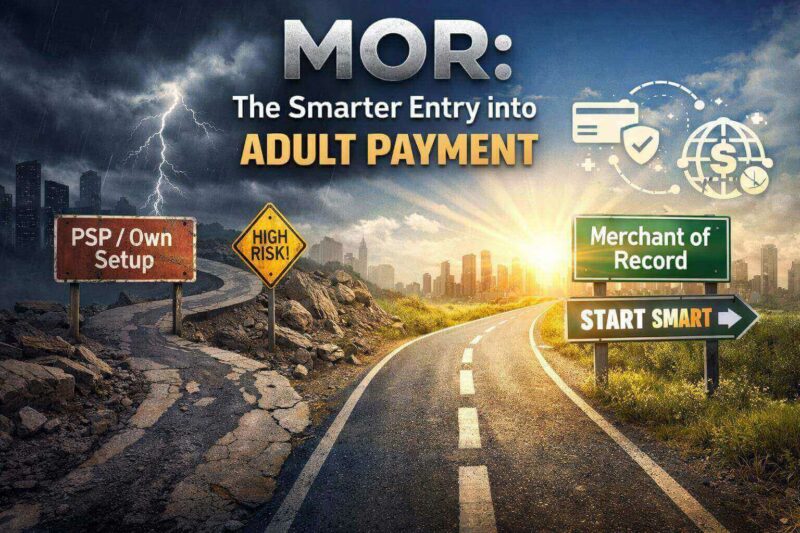
Why Merchant of Record makes entry into adult payment operationally cleaner
This is exactly where one of the practical strengths of Merchant of Record becomes visible. In today’s adult payment and high-risk payment market, entry is not only about whether a business can go live technically. The real question is whether it can be run cleanly from day one. Many new or growing businesses underestimate how quickly an early direct setup can create internal friction. Responsibilities are not yet settled, workflows are not yet stable, and the underlying payment infrastructure is often not mature enough to support a direct structure calmly and reliably. That is why Merchant of Record has become the more sensible first step for many businesses.
The difference does not show up in a presentation. It shows up in operations. A business that starts with its own direct setup has to carry a structure very early that often demands more discipline, more internal maturity, and more operational stability than the model has actually built so far. That is where friction begins. Not because the business model itself is weak, but because too many operational demands land inside the business too early. Merchant of Record structures that entry differently. The business does not have to behave from day one as if its full direct structure were already fully mature. It can enter the market on a cleaner and more workable first stage.
That is an important distinction in today’s market. Entry into adult payment is still often treated as if early direct control were automatically the more professional route. In practice, the opposite is often true. The more professional entry is the one that creates fewer operational breakpoints in the first phase and allows the business to grow into the market in a controlled way. That is why Merchant of Record is often not a detour today, but the better sequence. Not maximum depth in the first phase, but an entry model that remains operationally clean and workable.
Why this entry question should not be mixed with later model size questions
This article depends on a distinction that the market still handles too loosely. The question of how to enter adult payment sensibly today is not the same as the later question of expansion, scaling, or more complex model structures. Once both are mixed together, an entry-stage decision quickly turns into a broad strategic debate that misses the real point. That is exactly what this article is not trying to do.
This article answers only the first and more important question for the early phase: which model carries the start more cleanly today? Under current market conditions, the answer has become clearer for many businesses. In adult payment and high risk payment, Merchant of Record is often the more sensible entry model because it does not assume, from the first phase onward, a level of direct depth that is often not yet internally stable. That is where the practical strength of this approach lies.
This article deliberately does not decide more than that. It does not claim that every later structural question is already answered, and it does not suggest that every further model decision can automatically be derived from this first point. Its argument is narrower, and that is exactly why it is useful: anyone who wants to enter the market cleanly today should not overload the entry question with later-stage expansion logic. That is precisely what makes Merchant of Record so often the more sensible first layer.
What a new project should prepare cleanly before entering adult payment
A new entry into adult payment does not begin only where payments are technically accepted. It begins earlier, at the point where a business is prepared in a way that allows its first market phase to work cleanly at all. That is exactly why it is a mistake to think too early in the direction of the most direct own payment structure possible. In the early phase, what matters more is that the offer, market presence, technical foundation, and operational flow come together in a way that can actually support a viable launch.
This is also the point where it becomes clear why Merchant of Record is now the more sensible entry model for many businesses. The advantage is not only that payments can be processed. The advantage is that a project does not need to be built from day one as if every layer of direct payment depth were already fully developed internally. Especially in adult payment and high-risk payment, this sequence has become decisive. First a stable initial market phase, then more structural depth later if and when it can genuinely be carried.
This also includes the preparatory build-up work. Anyone setting up a new site, shop, or platform in the adult sector is already shaping part of the later payment reality. That preparatory stage is not a side topic. It is part of the same entry logic. In that context, a specialized external partner such as Erotik Webagentur can also be placed naturally if the goal is to put the upstream operational base in place cleanly.
The practical consequence is therefore clear. A new model should not first be planned to look as direct as possible on the payment side. It should first be prepared in a way that makes the entry phase sustainably workable. That is exactly why Merchant of Record is now the more sensible first step for many new projects in adult payment.
Conclusion
Anyone entering adult payment today with the old reflex of first trying to find a PSP as quickly as possible or building a direct setup early is often reading the market the wrong way. For a long time, that was the standard way of thinking. Under current conditions, it is no longer the most sensible entry path for many business models.
The decisive point is not how direct a structure looks on paper. The decisive point is whether it can actually carry the first real market phase cleanly. That is exactly where Merchant of Record becomes the more sensible first layer for many businesses in adult payment, erotic payment, and high-risk payment. Not as a fallback option and not as a comfortable detour, but as a model that often reflects the reality of market entry more honestly than the early reflex toward a direct own setup.
Anyone who wants to read the market correctly today therefore has to leave that wrong sequence behind. At the beginning, the issue is not maximum direct control. It is a market entry that is operationally, structurally, and organisationally workable. That is exactly why Merchant of Record is now for many businesses not the second thought, but the right first one.
FAQ
Is Merchant of Record now often the right first step in adult payment?
Yes. For many business models, Merchant of Record is now often the more sensible first step because entry into adult payment no longer depends only on whether payments can be technically accepted. What matters is whether the business can carry its first real market phase cleanly. That is exactly where Merchant of Record is often closer to market reality than the early reflex toward a PSP or a direct own setup.
Why does a clean entry into adult payment often no longer begin with a direct own setup?
Because a direct own setup often demands more at the beginning than a new or growing business can actually carry cleanly in its first phase. In adult payment, entry is therefore often strongest not where it looks most direct, but where it is structurally and operationally workable. That is exactly why Merchant of Record has become the more sensible first layer for many businesses.
Why is Merchant of Record in high-risk payment still too often misunderstood as a fallback option?
Because many still read the market through an older logic. They think of Merchant of Record as a reserve for difficult cases instead of a sensible entry structure. In today’s high-risk payment market, that is too narrow. For many businesses, Merchant of Record is not the second choice after failure, but often the better first decision.
What is the wrong entry question in erotic or adult payment today?
The wrong question is still often: Which PSP accepts adult, or how quickly can a direct setup be built? That question is too narrow because it treats entry as a provider issue or a direct-model issue. The more important question today is which structure can actually carry a clean start. That is exactly the point at which entry shifts toward Merchant of Record for many businesses.
Which entry logic is now often more viable in adult payment than the direct reflex toward a PSP or an own model?
The more viable logic is usually to think first in terms of a clean first market phase, not maximum early directness. A business that enters adult payment through a structure that can carry the beginning operationally will usually build more solidly than one that pushes too early toward maximum direct control. That is why Merchant of Record is now often the more realistic entry logic.
Why does Merchant of Record change the answer to a search for erotic or adult payment?
Because the question itself has changed. In many cases, someone searching for erotic payment or adult payment is no longer only looking for a payment provider, but for a viable entry structure. That is exactly why Merchant of Record now belongs much earlier in the answer than classic PSP logic or direct own-setup logic.