Anyone setting up a WooCommerce store for adult, fetish or BDSM offers usually notices sooner than expected that the real issue is not the shop system, but payment. Especially with adult payment for WooCommerce, many solutions look suitable at first glance and seem easy to implement, at least until the underlying business model is reviewed in more detail. Once onboarding starts, the business category is assessed or the setup moves into day-to-day operations, limitations often become visible that are far less common in other e-commerce segments.
One reason is that adult, fetish and BDSM businesses are not treated like ordinary online stores by many payment providers. Even if WooCommerce is technically well implemented, this does not automatically mean that onboarding, acquiring, payment methods and risk controls actually fit the business model. This is where declines, unstable setups, restrictions around recurring billing or broader operational issues often begin to appear, directly affecting conversion and revenue.
For operators, payment is therefore not just a technical checkout component, but a business-critical part of the overall infrastructure. Many merchants discover too late that a setup which works formally is not necessarily one that remains stable under real operating conditions. That is why adult payment WooCommerce has to be evaluated beyond integration alone and in the context of the entire payment structure behind the store.
Why Standard WooCommerce Payment Often Falls Short in the Adult Segment
Many merchants initially assume that payment in the adult, fetish or BDSM segment can be handled in much the same way as in other WooCommerce projects. From a technical perspective, the integration is often implemented quickly, especially when WordPress and WooCommerce are already set up properly. In practice, however, a working plugin does not automatically mean a sustainable payment structure. Anyone looking more closely at high risk payment quickly sees that the issue is not just connectivity, but whether the entire setup actually matches the business model.
The key issue is that standard providers may appear to fit WooCommerce well, while only covering the real business model to a limited extent. This affects not only business approval itself, but also risk assessment, acquiring, payment methods, reserve structures and recurring billing. In sensitive segments, it is therefore not enough to focus on technical integration alone. The foundation of the store also matters. Businesses launching a new project or rebuilding an existing one often need not only payment expertise, but also a clean WordPress and WooCommerce implementation, which can be supported by a specialized adult agency for WordPress and WooCommerce stores.
Another challenge is that problems rarely become obvious immediately. Some setups look stable at first, until volume increases, chargebacks rise, reviews become stricter or certain product categories trigger restrictions. That is why adult payment WooCommerce is not a standard setup topic, but an infrastructure issue that goes far beyond the checkout itself.
Where Problems Usually Become Visible in Day-to-Day Operations
In the adult segment, the real difficulties often do not begin at go-live, but only once a WooCommerce store is exposed to real operating conditions. As long as transaction volume, product mix and customer behavior remain manageable, some setups may appear stable at first. The critical point usually comes when reviews become stricter, chargebacks increase or the actual payment behavior no longer fits the pattern expected by a standard provider. This is where it becomes clear whether a store has merely been connected technically or whether the payment setup is operationally sustainable.
Especially in adult payment, problems rarely show up as a clear system failure. In many cases, checkout continues to function formally while the real weaknesses emerge elsewhere: individual payment methods perform worse, transactions are declined inconsistently, approvals remain in place only with restrictions or recurring payments no longer run as reliably as planned. This is particularly difficult for merchants because such developments often happen gradually and are not immediately recognized as payment-related, even though they already have a direct impact on conversion, customer retention and revenue.
Another factor is that WooCommerce stores in sensitive segments often need to support far more than a simple one-time purchase. Depending on the business model, this may include digital content, memberships, credits, recurring services or hybrid offers. This significantly raises the demands placed on payment. If acquiring, payment methods and risk controls are not aligned with that commercial logic, operational friction appears exactly where it matters most: at checkout itself, during renewals, in recurring billing flows and in the stability of day-to-day processing.
A further issue is that unstable setups often look harmless from the outside at first. The store is live, payments are coming in and technically everything appears to work. Only over time do patterns begin to emerge: certain customer groups drop off more often, specific markets perform worse, approval rates decline or support and review effort increase. In practice, this means that a setup which works formally is still far from being a reliable basis for growth. Especially with adult payment WooCommerce, the key is therefore not just integration, but the ongoing resilience of the entire payment structure.
For merchants, the challenge is also that these problems rarely occur in isolation. A slightly higher decline rate, unclear restrictions around payment methods or unstable subscription logic may each seem manageable on their own. Taken together, however, they can create exactly the kind of dynamic that becomes expensive in day-to-day operations: lower conversion, more abandoned checkouts, higher operational friction and less predictability in growth. That is why the true quality of a payment setup in the adult segment is not visible in a demo checkout, but in live operations under real conditions.
Why Sustainable WooCommerce Payment Setups Break Down in the Adult Segment
Many difficulties in the adult segment do not arise because WooCommerce itself is unsuitable as a shop system. The real problem is usually that payment is treated as nothing more than a checkout topic. In less sensitive industries, that may be enough for simple setups. In adult, fetish or BDSM businesses, however, this view is too limited, because the issue is not just technical integration, but whether the business model, risk logic and payment flow actually fit together.
In practice, sustainable setups often fail because too much attention is placed on the visible surface too early. The store works, the plugin is active and payments can generally be accepted. What is easily overlooked is that a formally connected payment setup says very little about how resilient it will be under real operating conditions. Especially with adult payment WooCommerce, the difference often becomes visible only when recurring billing has to run reliably, certain product groups are reviewed more closely or transaction patterns begin to shift.
Another issue is that standard solutions are usually designed for business models that can be categorized in a clear and simple way. In the adult segment, that clarity is often missing. Some stores operate with mixed product structures, others with digital offers, memberships or ongoing services. This increases not only the technical demands on payment processing, but also the need for industry understanding, risk assessment and operational control. That is exactly where friction appears when payment is treated as a plugin question rather than as infrastructure.
A resilient setup therefore has to do more than simply accept payments. It must fit the actual business model, remain stable under ongoing load and continue to perform even when volume, product mix or payment behavior changes. Without that foundation, the result is not always an immediate outage, but the kind of friction that gradually makes a store harder to manage in daily operations.
What Defines a Sustainable WooCommerce Payment Setup in the Adult Segment
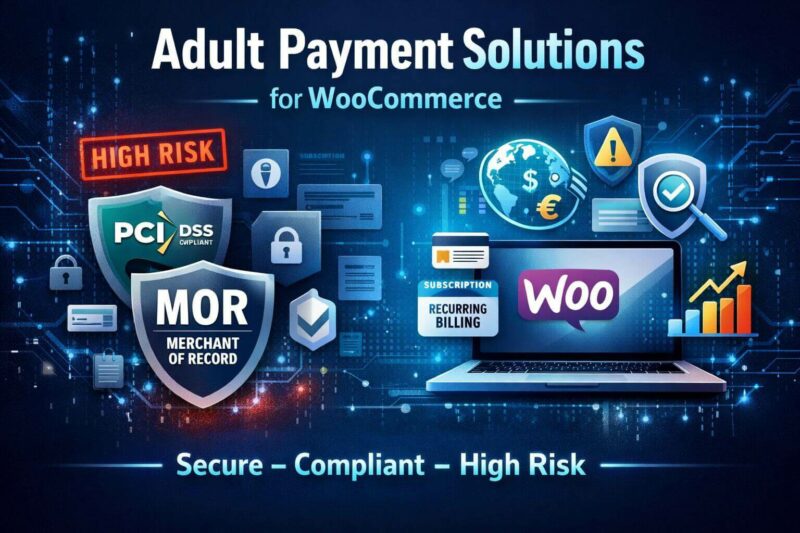
A resilient setup in the adult segment does not begin with the question of which plugin can be activated in WooCommerce most quickly. What matters is whether payment is designed from the outset in a way that actually matches the business model, risk logic and operational reality of the store. This is exactly where many setups fail: the technical connection is in place, but the structure behind it is too narrow to remain stable in everyday operations.
Especially in adult, fetish or BDSM businesses, it is not enough to be able to accept payments on a purely formal level. A sustainable setup also has to keep working when product mix, volume, payment behavior or recurring services become more complex. That requires business approval, acquiring, payment methods, billing logic and risk controls to work together properly. Only when these layers are aligned does a setup become something that holds up not just in a test environment, but under real operating pressure.
For merchants, this means that payment has to be treated as part of the overall business structure, not as an isolated checkout component. Anyone running WooCommerce professionally in a sensitive segment therefore needs more than technical connectivity. They need a well-structured payment infrastructure for creators and platforms built for ongoing operations, scaling and control. That difference often determines whether a setup works only in the short term or remains sustainable over time.
In the end, the issue is not about having as many checkout features as possible, but about stability, fit and operational resilience. WooCommerce can work very well in the adult segment, but only if payment is not treated like a standard module and instead understood as a business-critical part of the infrastructure.
What a Strong WooCommerce Payment Setup Actually Needs to Deliver
In the adult segment, it is not enough for a payment method in WooCommerce to work on a purely technical level. What matters is whether the setup remains stable under real operating conditions and actually fits the business model behind the store. This is where many projects run into problems in practice: checkout is connected, payments are formally possible, but the structure behind it is not designed to support ongoing load, recurring processes and sensitive risk logic in a reliable way.
A strong setup therefore has to do more than simply accept transactions. It needs to be built so that payment methods, billing logic, acquiring and risk control do not exist side by side, but work together as one structure. In WooCommerce stores related to adult, fetish or BDSM, this alignment often determines whether a setup only appears functional in the short term or actually remains reliable in day-to-day operations. Even small breaks in that logic can be enough to make conversion, renewals or ongoing payment flows unnecessarily unstable.
It is equally important that payment matches the actual structure of the store. A business selling physical products has different requirements from one built around digital content, memberships, credits or recurring services. When these differences are addressed too late, the result is often a setup that works on paper but is too narrow operationally. That is why payment in this environment should not be treated as a plugin topic alone, but as part of the broader business infrastructure behind the store.
Which Business Models Make This Especially Relevant in WooCommerce
How demanding a WooCommerce payment setup becomes always depends on the actual business model behind it. In the adult segment, there is rarely one standard case. Some stores sell physical products, others are built around digital content, memberships, credits or models where several types of services overlap. These differences matter because they directly shape how resilient the payment setup needs to be in daily operations.
In traditional product-based stores, the payment logic may still be relatively straightforward. Even there, however, simply being able to accept payments technically is not enough once the business falls into a sensitive segment. The picture changes even more when the store is built around access models, recurring services or an ongoing customer relationship. In those cases, the demands on billing, renewals, payment stability and operational control increase significantly. A setup that may be acceptable for one-time purchases is often too limited for these models.
The challenge becomes even greater when WooCommerce is not used as a simple online store, but as the basis for a business moving toward creator, membership or platform-like structures. At that point, payment is no longer just about checkout. It becomes part of how the entire commercial model is actually delivered. This is where it becomes clear why sensitive businesses need more than a standard plugin and why the lines between store logic, billing and payment have to be aligned carefully in live operations.
For merchants, this is a crucial point, because the payment setup should never be chosen separately from the business model itself. A WooCommerce store for physical products has to be assessed differently from a setup for digital content, memberships or recurring services. Merchants who define these differences early create a much stronger basis for stability, conversion and predictable growth.
When a Merchant of Record Model Can Make Sense for WooCommerce
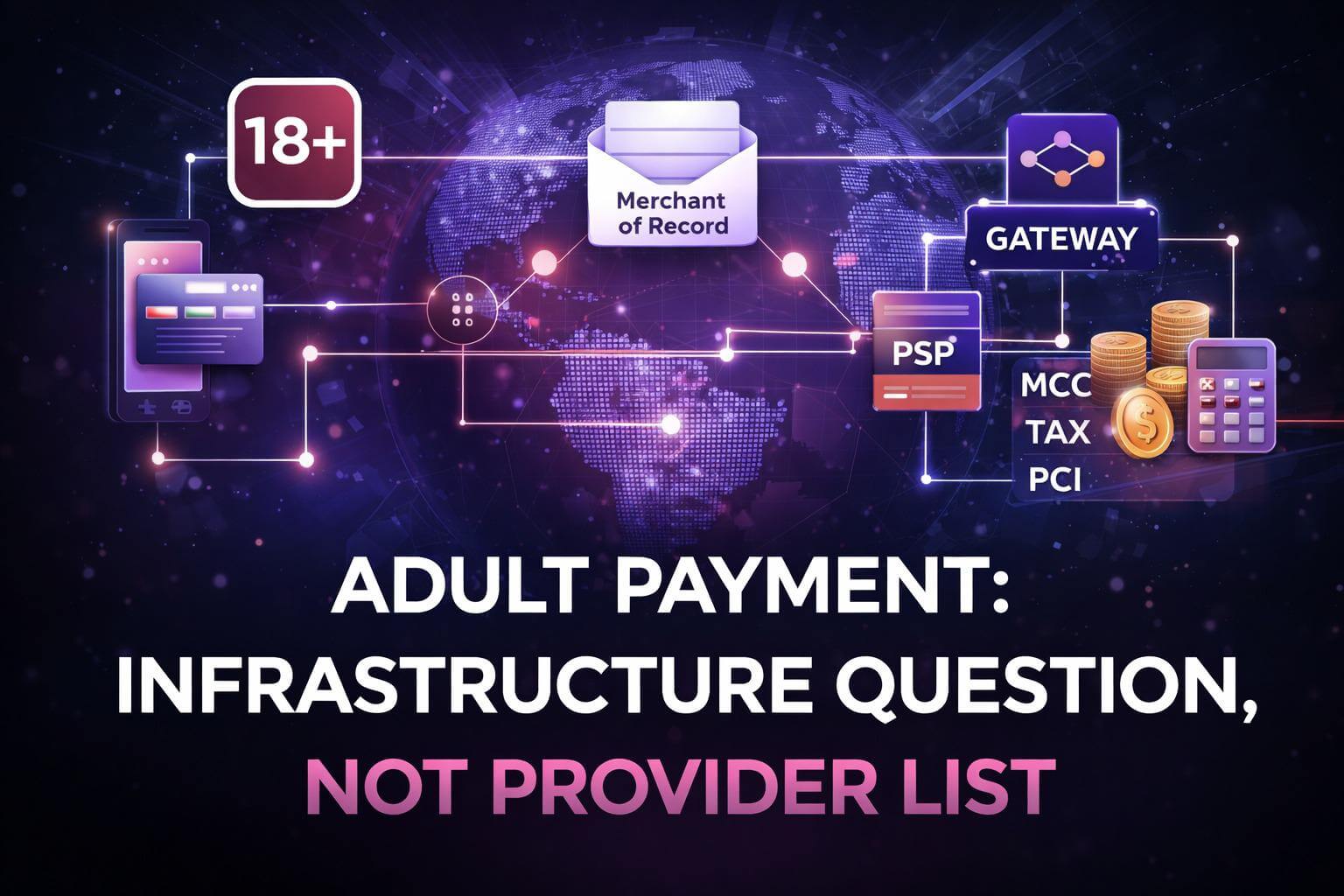
Not every adult business model can be supported equally well over the long term through a conventional payment setup. Especially when WooCommerce is used not just for one-off product sales, but for digital services, memberships, recurring billing or creator-related models, the structural question often goes beyond a simple gateway or acquiring decision. In those situations, it can make sense to also consider a Merchant of Record model.
The value of that approach is not that payment suddenly becomes “easy.” The more relevant point is that certain operational, billing-related and structural requirements can be organized differently than in a conventional setup. For business models built around more than a straightforward one-time purchase — especially those involving ongoing services, digital access or international scale — that can make a meaningful difference.
This does not mean that MOR is always the better option. But it is often a worthwhile consideration when a WooCommerce setup in the adult segment works technically, yet begins to show operational limits. That is why the decision should not be reduced to plugin A versus provider B, but should include different infrastructure models, depending on how the business is actually structured.
Conclusion: WooCommerce Can Work in the Adult Segment, but Not with Every Payment Setup
WooCommerce can absolutely be a viable foundation for adult, fetish and BDSM business models. In practice, the real issue is usually not the store itself, but whether the payment structure actually fits the business behind it. This is exactly where many setups are designed too narrowly. Technical integration may be quick, but only day-to-day operations reveal whether approval, acquiring, payment methods, billing logic and risk controls truly work together in a stable way.
Especially in the context of adult payment WooCommerce, it is therefore not enough to look for a provider that can somehow be connected. What matters is whether the setup remains stable when volumes grow, recurring payments are introduced, product structures become more complex or the business model demands more than a simple one-time transaction. This is the point where a formally working payment setup is separated from one that can actually support live operations over time.
For merchants, that means one thing above all: payment should not be treated as a secondary checkout question, but as a business-critical part of the infrastructure. Simplifying this too early rarely saves real time or effort. In most cases, it only pushes the problem further down the line — in the form of operational friction, unstable processes, lower conversion or reduced ability to scale. That is exactly why a proper structural evaluation matters before a setup is pushed into growth.
WooCommerce can work very well in this segment. But not simply because a plugin is installed or a standard provider remains formally available. A setup only becomes reliable when it actually matches the business model, operational reality and risk logic of the store. In the adult segment, that is what ultimately matters.
FAQ
Is adult payment with WooCommerce always high risk?
Yes. Adult payment is always high risk. For merchants, that means stricter review, clear industry classification, higher monitoring requirements, greater sensitivity around chargebacks and far less tolerance than in standard e-commerce. That is exactly why a standard WooCommerce payment setup is usually not enough in this segment.
Why is a standard payment provider often not enough for WooCommerce in the adult segment?
Because standard providers are built for conventional e-commerce models. Adult, fetish and BDSM follow a different risk and processing logic. What matters here is not only technical integration and checkout, but MCC structure, acquiring capability, billing logic, chargeback resilience and long-term operational stability. This is exactly where standard setups regularly break down.
How important are recurring payments in adult payment for WooCommerce?
They are critical. As soon as a model includes memberships, credits, access, subscriptions or ongoing services, the requirements increase immediately. At that point, it is no longer just about a successful initial transaction, but about renewals, retry logic, billing processes, status changes and clean operational control over time.
How can merchants tell that a WooCommerce payment setup is not operationally strong enough?
By patterns, not just outages. Typical signs are falling approval rates, inconsistent declines, unstable recurring flows, rising manual workload, checkout friction or problems in certain markets, products or payment methods. When those signals appear, the setup may be technically live, but structurally it is usually too weak for the business model.
Is it enough if a provider generally accepts the industry?
No. Industry acceptance alone means very little if the structure behind it does not hold up. What matters is under which high-risk logic the business is processed, which billing structure is possible, how stable recurring payments remain and whether the setup truly matches the product logic, customer behavior and risk profile of the business.
When can a Merchant of Record model make sense for WooCommerce?
When the business model needs more than a conventional merchant setup. This is especially true for digital services, memberships, recurring billing, creator-driven models, platform logic and more international structures. That is exactly where a high-risk MOR shows its strength, because it does not leave the operational and regulatory complexity with the merchant.
Does a high-risk MOR solve the full compliance layer?
Yes. That is exactly what a high-risk MOR is designed to do. A MOR takes over the entire compliance and operational responsibility layer around payment, tax, fraud, disputes, billing and regulatory handling. That is what fundamentally separates a MOR model from a conventional gateway or acquiring setup. The merchant sells, the MOR carries the structural burden.
Does MOR also solve PCI exposure for the merchant?
Yes. That is one of the core structural advantages of a MOR model. When the MOR fully takes over payment processing, the PCI-relevant responsibility sits there and not with the merchant. For high-risk business models, this is not just a technical benefit, but a major difference in day-to-day operational reality.